



Who this guide is for: anyone who has heard that Rocket Pool is "the decentralised way to stake Ethereum" and wants to understand what it actually does before connecting a wallet. It is written for a first-time staker, and it also covers the parts that matter to a more experienced holder, such as exit liquidity, the new Saturn 1 node design and the RPL token.
We tested this on three real devices (every screenshot was taken live on 16 November 2026, not stock images):
| Device | Width | What we opened |
|---|---|---|
| Desktop | 1440px | Marketing site, staking app (Stake, Unstake, menu), RockSolid vault page, node app, docs, governance forum |
| Tablet | 1024px | Homepage, Stake, Unstake, docs, governance forum |
| Phone | 430px | Homepage, Stake, Unstake, RockSolid vault, menu, docs |
We also connected a throwaway MetaMask wallet that holds no funds to the staking app and opened every page we could reach. Because the wallet is empty, the app showed "Insufficient balance" on the main button, so we did not stake, unstake or sign anything. That means we cannot tell you how a real deposit feels, how long a withdrawal takes in practice, or what the node setup is like on a server. Wherever a statement comes from the documentation instead of our own click, we write "the docs say".
Quick verdict: Rocket Pool lets you swap ETH for rETH, a token that slowly becomes worth more ETH as staking rewards build up. It is the best known decentralised alternative to Lido, it lets almost anyone run a validator with as little as 4 ETH under the new Saturn 1 design, and it has been live for years. The trade-offs are real: it is about 5% the size of Lido, the headline staking yield is low (1.83% in the app today), and the protocol itself currently has 0 ETH of instant exit liquidity, so unstaking depends on a market route. Treat it as a mature but smaller staking protocol, not as a risk-free savings account.
| Item | Detail |
|---|---|
| Best for | ETH holders who want liquid staking from a decentralised protocol, and home stakers who want to run a validator with a small bond |
| Fees | No deposit fee shown in the app, node operators take a commission from rewards, network gas applies (the CoW Swap exit route is gasless) |
| Custody | Non-custodial smart contracts, you connect your own wallet |
| Main chain | Ethereum mainnet |
| Headline rate | 1.83% APR liquid staking (7-day average), 3.84%+ for the third-party RockSolid vault (16 November 2026, these change) |
| Editorial score | 4.0 / 5 |
What Is Rocket Pool? (Plain English)
Ethereum is secured by people who lock up ETH and run software called validators. Each validator needs 32 ETH to start, and the network pays rewards for doing the job properly. Most people do not have 32 ETH, do not want to run a server, or do not want their coins locked with no way out.
Think of Rocket Pool as a shared investment fund for validators. You hand over any amount of ETH, from 0.01 ETH, and receive a receipt token called rETH. Independent node operators, who are people running real validators on their own machines, use the pooled ETH to do the work. The rewards flow back into the pool, so each rETH slowly becomes worth more ETH. You do not run anything yourself.
In plain terms: put in ETH, get rETH. Hold rETH while it grows in value against ETH. Swap it back whenever you want. The rewards are not paid to you as new tokens, they are built into the price of rETH.
Who built it? Rocket Pool is an open protocol governed by its token holders. The app footer names the legal entity Rocket Pool Pty Ltd. The marketing site calls it the leading decentralised liquid staking protocol for Ethereum. We did not verify who the individual developers are, and the docs focus on the protocol rather than on people.
Key facts (16 November 2026):
| Fact | Value | Source |
|---|---|---|
| Total value locked | $868.0M | DefiLlama (category Liquid Staking) |
| ETH staked | 535,136 ETH | Rocket Pool app footer |
| Validators | 16,723 | Rocket Pool app footer |
| Liquid staking APR | 1.83% (7-day average) | Rocket Pool app |
| Node staking APR | 3.50% plus RPL rewards | Rocket Pool homepage |
| rETH price | $2,121.82 | CoinGecko |
| rETH market cap | $643.9M | CoinGecko |
| RPL price | $1.22 | CoinGecko |
| RPL market cap | $27.9M | CoinGecko |
Why the numbers differ: the app counts 535,136 ETH, which at the ETH price of about $1,808 we saw in the app is roughly $967M. DefiLlama shows $868M. Different tools price ETH at different moments and count some assets differently, so use the DefiLlama figure for comparing protocols and the app figure for what Rocket Pool says about itself. The rETH market cap of $644M on CoinGecko is a third number, because it counts only rETH in circulation.

How Rocket Pool Looks on Your Device
Rocket Pool is split into several sites. rocketpool.net is the marketing site, stake.rocketpool.net is the app where you connect a wallet, node.rocketpool.net is a node dashboard, docs.rocketpool.net is the documentation, and dao.rocketpool.net is the governance forum. The RockSolid vault is reached from inside the staking app but is run by a different company.
On a Laptop or Desktop Computer (1440px wide)
The homepage opens with the line "Stake your ETH, earn rewards, and help secure Ethereum" and three buttons for Liquid staking, Node staking and DeFi Vaults (the last one carries a NEW badge). A single orange Launch button in the menu opens the app. Scrolling shows one section for each product with simple illustrations and short bullet claims such as "Any amount" and "Earn rewards over time".

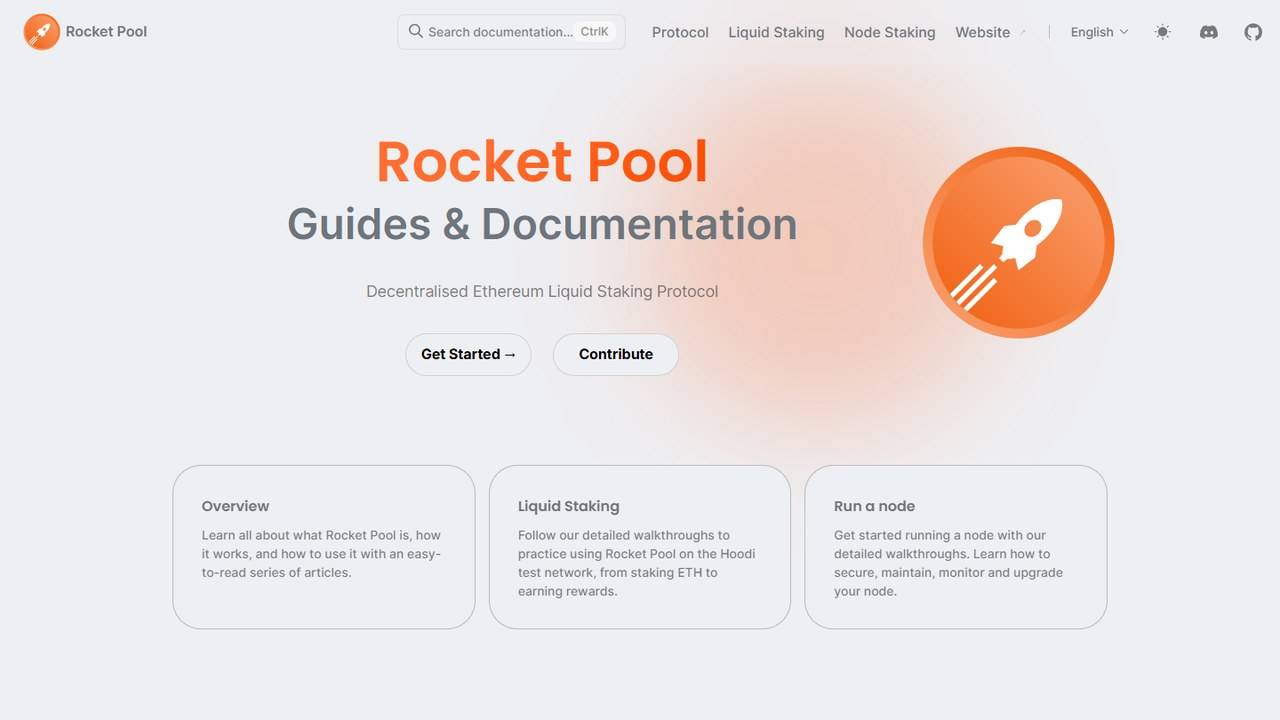
The docs site is a clean reading layout with search and a left menu. The governance forum is a standard Discourse forum with categories such as Governance, Node Operator Experience and Grants and Bounties.

On a Tablet (1024px wide)
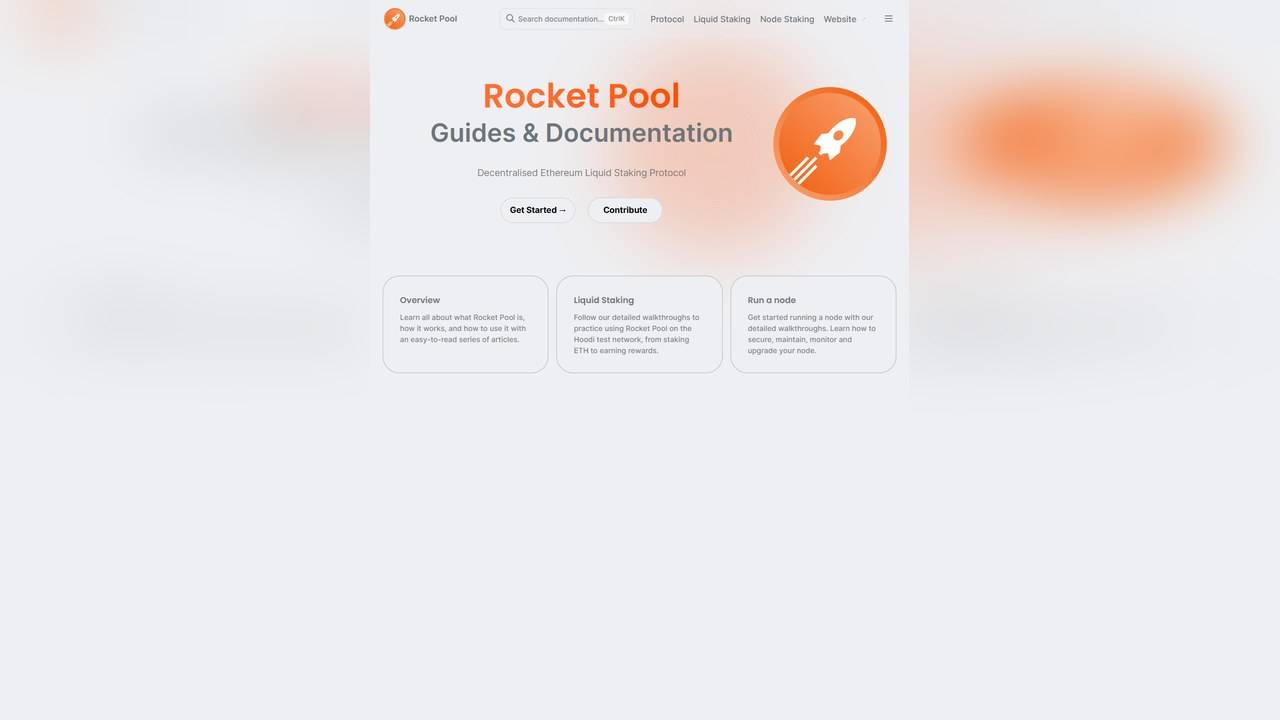
The tablet layout keeps the same content and stacks it in one column. The navigation stays visible, the illustrations scale down and nothing overlapped in our test. The staking app on a tablet is a centred card with the same fields as on desktop.


On a Phone (430px wide)
On a phone the menu collapses into a burger icon, and the app becomes a single tall card. Every input and button was reachable with one thumb. The staking numbers are small but readable. The docs site on a phone shows a search icon, a Get Started button and an Overview card, and there was a thin horizontal scrollbar at the bottom of the docs page in our capture, which is a minor layout flaw.

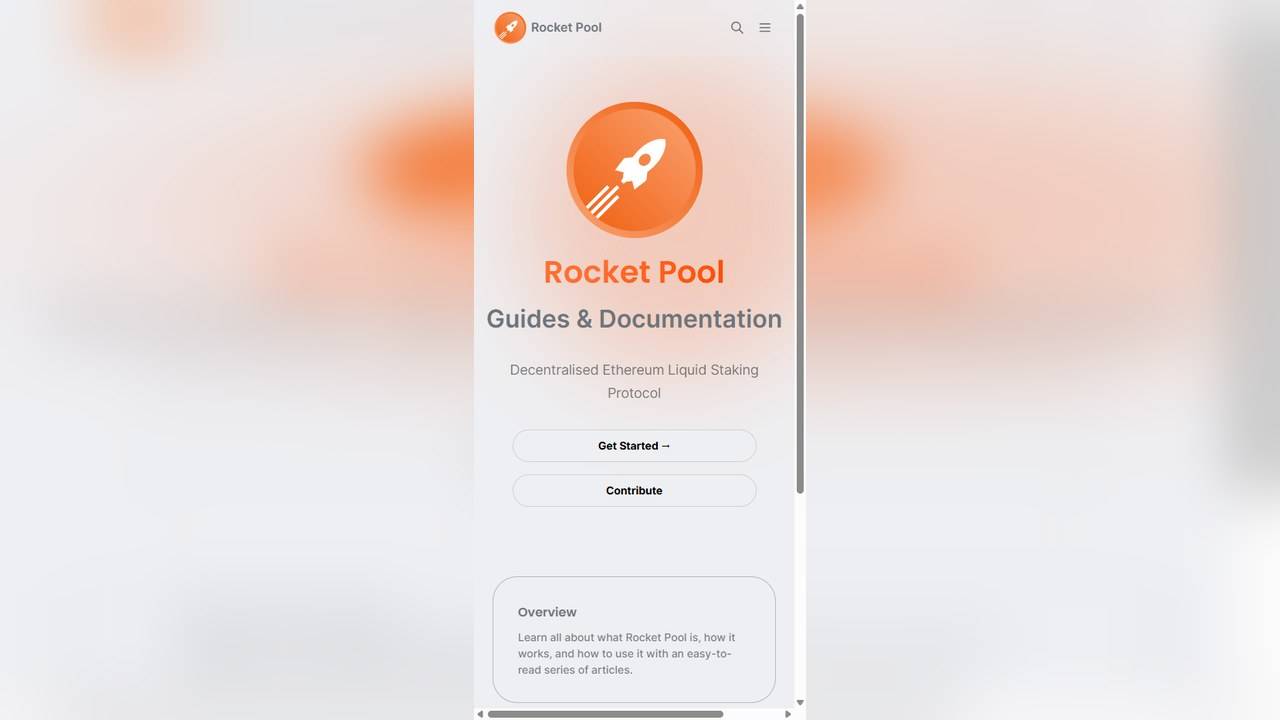
Our take on device support: the apps are responsive and usable on all three sizes. This is a lighter, simpler interface than most DeFi dashboards, which suits a beginner. The app also has a light and a dark theme, and the connected view opens in dark.
Connecting Your Wallet
We used a MetaMask wallet with no funds and never approved a transaction.
- Open stake.rocketpool.net. Before connecting, the page shows the Stake card with a Connect Wallet button.

- Click Connect Wallet. A picker built on Reown (formerly WalletConnect) lists WalletConnect, MetaMask, Coinbase Wallet, Trust Wallet and Binance Wallet, plus a search field. There is a Terms of Service checkbox that you must tick first.

- Choose MetaMask. MetaMask opens its own window.
- In MetaMask you see the site name stake.rocketpool.net and the permissions. MetaMask states that the site can see addresses, balances and activity and can send requests for transactions, but cannot move funds without your permission. Click Connect.
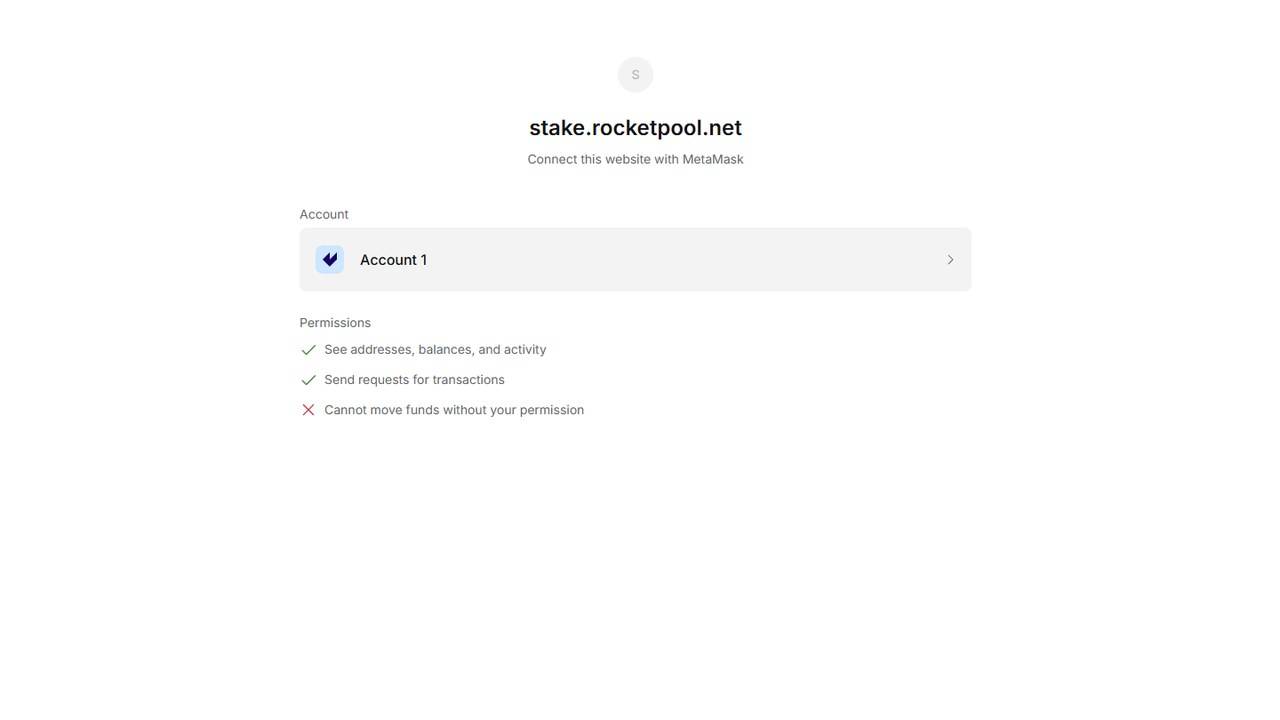
- The app returns to the Stake page with your shortened address at the top right.

Beginner safety tip: connecting only shares your public address. The dangerous step is signing a transaction or approving token spending. Always read the MetaMask window, and use the address bar to confirm you are on stake.rocketpool.net before connecting. Fake copies of well known DeFi sites are common, so bookmark the real address.
Core Features at a Glance
| Feature | What it does | Tested by us |
|---|---|---|
| Liquid staking (Stake) | Swap ETH for rETH from 0.01 ETH | Page opened, quote read, no deposit |
| Unstake | Swap rETH back to ETH through the protocol or CoW Swap | Page opened, quotes read, no swap |
| rETH token | Value-accruing receipt token | Price and supply checked on CoinGecko |
| RockSolid rETH Vault | Third-party vault that wraps rETH for extra yield | Page and disclaimer opened, no deposit |
| Node staking and megapools | Run a validator with a 4 ETH bond | Docs read, node app opened, no node run |
| RPL token and revenue split | Token for node operators and governance | Data checked, docs read |
| Governance | pDAO, Oracle DAO and Security Council | Forum and docs read |
| Smoothing Pool and MEV | Shares block rewards among node operators | Docs only |
Feature 1: Liquid Staking (Swap ETH for rETH)
This is the main product. On the Stake page you type an amount of ETH at the top and the app shows how much rETH you receive underneath. In our test, 1 ETH was quoted as 0.850023 rETH (about $1,808 in, about $1,808 out, so no visible hidden charge in the quote). The page also shows an Exchange Rate row, an Average Return row (about 1.83% APR) and a Transaction Cost row with the current gas price and a small "Low" label.
There are two routing choices:
- Protocol: you deposit into the Rocket Pool deposit pool directly and the smart contract mints rETH at the official exchange rate.
- CoW Swap: the app asks the CoW Swap exchange for a quote. In our capture CoW quoted about 0.8506 rETH for 1 ETH, which is slightly more rETH than the protocol gave (0.850023). That is possible when rETH trades at a small discount on the open market.
The "What's the difference?" link explains the choice. For a beginner the protocol route is the simplest, and the CoW route is worth a glance only when the quote is clearly better.


Docs say: the minimum is 0.01 ETH, and your rETH is an exchange-rate token. That means the number of rETH in your wallet stays the same, and each rETH is worth more ETH as time passes. The rate includes Beacon Chain rewards, priority fees and MEV rewards earned by the validators. Because your balance does not grow, many wallets show a flat rETH balance, which surprises first-time users.
Not tested: a real deposit, because our test wallet held no ETH.
Feature 2: Unstaking (and the 0 ETH Liquidity Warning)
This is the part every beginner should read twice. The Unstake page lets you type an amount of rETH and shows what ETH you would receive, again with two routes.
In our capture the Protocol route was greyed out and labelled "Insufficient liquidity", and the Protocol Liquidity row showed 0.00 ETH. The footer of the app says the same thing in plain words: 0 ETH exit liquidity, 21,664 ETH needed to dequeue all validators, and 677 validators queued to begin staking. The CoW Swap route was marked Available.
| Unstake detail (1 rETH test input) | What the app showed |
|---|---|
| ETH received via CoW Swap | 1.175096 ETH (about $2,125) |
| Minimum received | 1.16922 ETH |
| Slippage tolerance | 0.5% |
| Order expiry | 30 minutes |
| Network fee | 0 ETH (gasless) |
| Protocol route | Insufficient liquidity |

What this means in plain English: the protocol itself can only hand out ETH when there is ETH sitting in its deposit pool. Right now there is none, because new deposits are being sent to validators. So to get ETH back, you sell your rETH through the CoW Swap market. We worked out the cost: at the protocol rate, 1 rETH is worth about 1.1764 ETH (the reverse of 0.850023), while CoW offered 1.175096 ETH. That is a gap of roughly 0.11% in our single sample. It is small today, but it is a market price, so in a stressed market the discount could be larger, and we only measured one moment.
The homepage promises that you can unstake at any time with no minimum lock-up. That is true in the sense that no one stops you from selling, but in practice, with 0 ETH of protocol liquidity, that promise depends on the market route working.


Docs say: direct unstaking through the protocol only works when the deposit pool has ETH. Otherwise you should use a decentralised exchange, and you may pay a "small premium". This matches what we saw.
Not tested: an actual swap and the time CoW Swap takes to fill an order.
Feature 3: The RockSolid rETH Vault (Third-Party, Labelled NEW)
In the side menu of the app there is a RockSolid rETH Vault item with a NEW badge, and the homepage promotes "DeFi Vaults" with a headline of 3.84%+ APR (7-day trailing). The idea is that you deposit rETH and a vault strategy tries to earn more than plain rETH.
Important: this is not run by Rocket Pool. The vault page carries a disclaimer, and the vault belongs to a separate company called RockSolid. RockSolid's own website describes it as infrastructure for funds, asset issuers and custodians. It shows "$25M+ deposits managed", "live in production since September 2025" and "zero losses or exploits". These are RockSolid's own marketing claims and we could not check them independently. It also lists Rocket Pool, Mavan, MegaETH, PierTwo and Lido as "in production with" names.


How to read the extra yield: the headline 3.84% is more than twice the 1.83% for plain staking, so something extra is being done with your rETH. Extra yield almost always means extra risk, such as another smart contract, a strategy that can lose money, or withdrawal limits. We did not review the vault's strategy, fees or audits in depth, so please read the vault disclaimer and RockSolid's own docs before depositing. The 3.84% is also a trailing 7-day number, not a promise.
Not tested: a deposit, the vault's withdrawal rules and its fees.
Feature 4: Node Staking and Megapools (Run a Validator with 4 ETH)
This is what makes Rocket Pool different from a simple staking token. Anyone can become a node operator, which means running validator software on their own computer. You do not need 32 ETH. The protocol supplies the rest from the pool of ETH that rETH buyers deposited.
The docs describe three generations of bond sizes:
| Design | Your bond per validator | ETH from the pool |
|---|---|---|
| Legacy minipool | 16 ETH | 16 ETH |
| Legacy LEB8 minipool | 8 ETH | 24 ETH |
| Saturn 1 megapool | 4 ETH | 28 ETH |
In the Saturn 1 design, one node can run many validators in a single "megapool". Each new validator goes through two steps on the Beacon Chain: a 1 ETH pre-stake, then the remaining 31 ETH. The docs also describe a planned Saturn 2 (proposal RPIP-42) where the first two validators need a 4 ETH bond and each later one only 1.5 ETH. That is a plan, not something live, so do not count on it.
What the operator earns, according to the docs: the base commission is 5% of rewards, and the docs show a table of how much more a megapool earns per ETH of bond compared with a minipool (35% per ETH bonded, about 2.3 times the 8 ETH minipool's 15%). Node operators are also paid in RPL, the protocol token, and the homepage shows 3.50% APR plus RPL rewards for node staking.

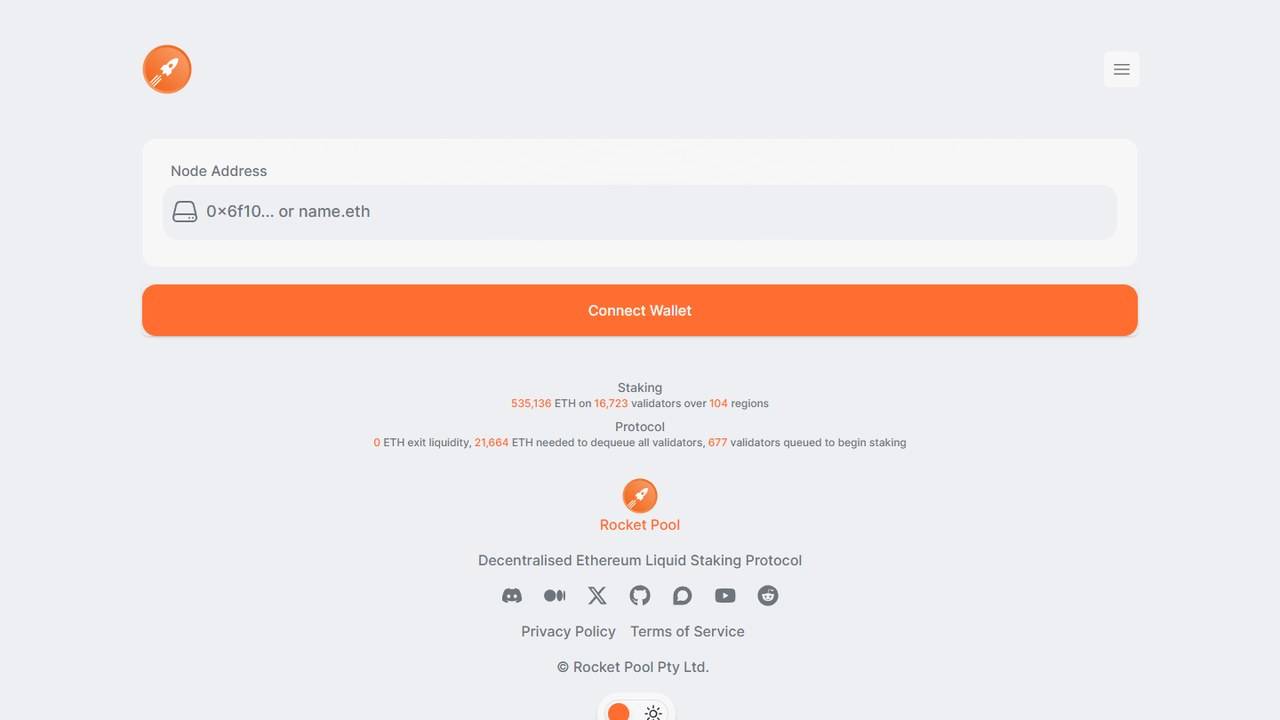
The node app at node.rocketpool.net asks for a node address and offers a Connect Wallet button. We opened it but have no node, so we saw only the entry screen. Running a node is also a job: it needs a computer that is online all the time, the Smart Node software, and care when upgrading. The docs also describe forced delegate upgrades (RPIP-47), which means the protocol can require a node's contract to update.
Who should do this: technical users who are comfortable with a command line and who accept that a validator can be penalised for being offline or for misbehaving. Who should not: anyone who just wants to earn yield on ETH. Buy rETH instead.
Not tested: installing the Smart Node, creating a megapool or any real validator work.
Feature 5: The rETH Token and How Rewards Are Split
rETH is the token you receive. It is an ordinary Ethereum token, so you can hold it, send it, or use it in other apps that accept it. Because it is worth more than 1 ETH (about 1.176 ETH each at the protocol rate we saw), its price on CoinGecko was $2,121.82 while ETH itself was near $1,808 in the app.
Under the new UARS design (Universal Adjustable Revenue Split, proposal RPIP-46), the docs say validator rewards are divided like this by default:
| Who | Default share of rewards |
|---|---|
| Node operators (base commission) | 5% |
| Voter share, paid to megapool RPL stakers | 9% |
| pDAO treasury | 0% |
| rETH holders | 86% (the remainder) |
All of these shares can be changed by governance (the pDAO), and the docs say reward periods last 28 days, with the Oracle DAO taking the snapshots. For you as an rETH holder this is the most important table: out of all validator rewards, the default says 86% reaches the rETH price. A recent forum thread we saw is titled "Is rETH's fee costing it demand? A data study", which shows the community itself is debating whether this cut is too high compared with rivals. We only saw the title and did not read the study, so we do not draw a conclusion from it.
Feature 6: The RPL Token (Price, Supply and Real Use)
RPL is the protocol's own token. Node operators stake it, and holders who stake it get voting power in the pDAO. In Saturn 1, the docs describe RPL as an ETH-accruing revenue-share token for megapool stakers, and RPL inflation rewards continue.
RPL data from CoinGecko (16 November 2026):
| Metric | Value |
|---|---|
| Price | $1.22 |
| Market cap | $27,927,529 |
| Fully diluted value | $27,927,529 |
| 24-hour trading volume | $667,913 |
| Circulating supply | 22,960,748 RPL |
| Maximum supply | None set |
| 24-hour change | +1.31% |
| 7-day change | -8.54% |
| 30-day change | -24.39% |
| 1-year change | -60.87% |
| All-time high | $61.90 (16 April 2023) |
| All-time low | $0.00885 (27 August 2018) |
| CoinGecko rank | 613 |
How to read it: RPL is down about 98% from its high and about 61% over the past year, and it trades only about $0.7M a day. That is thin. A holder who wants to sell a large amount would move the price. There is no maximum supply, because the protocol keeps issuing new RPL as inflation rewards. Treat RPL as a high-risk token that you buy only if you plan to run a node or take part in governance, and not as a way to earn staking yield.
Reminder: this guide is not investment advice. The prices above are a snapshot and change every minute.
Feature 7: Governance (pDAO, Oracle DAO and Security Council)
Rocket Pool is run by three groups, according to the docs:
- The protocol DAO (pDAO): RPL stakers vote on changes. Since the Houston upgrade this is done on-chain with an optimistic fraud-proof system, which means proposals are assumed valid unless someone proves otherwise.
- The Security Council: a council that handles security matters. We did not find a detailed description of its powers in the pages we read.
- The Oracle DAO: an invite-only group that reports Beacon Chain data and the rewards Merkle tree to the chain, and receives a small share of RPL inflation.
Discussion happens at dao.rocketpool.net, a Discourse forum. Categories include Governance (352 topics), Node Operator Experience (71), Growth (43) and Grants and Bounties (347). When we looked, the front page showed a treasury report, the Round 43 grant call with a deadline of December 7, and a data study on rETH demand. Posting and replying need an account. We only read the forum and did not vote, because voting needs staked RPL.
Honest note: an invite-only Oracle DAO means a certain amount of trust sits with a defined group, even though the protocol is "decentralised" in how it holds funds. This is also true of many staking protocols, and it is worth knowing.
Feature 8: Smoothing Pool, MEV and Other Extras (Docs Only)
Block rewards on Ethereum are lumpy. One validator may get a big payout from a lucky block and then nothing for months. The docs describe a Smoothing Pool that node operators can opt into, so rewards from many nodes are pooled and shared out evenly. They also describe MEV-Boost and Commit-Boost support (Commit-Boost was audited by Sigma Prime in December 2024, according to the docs), fee distributors and a Smart Node command line tool. We read these pages but did not run any of them, so this is a description and not a test.

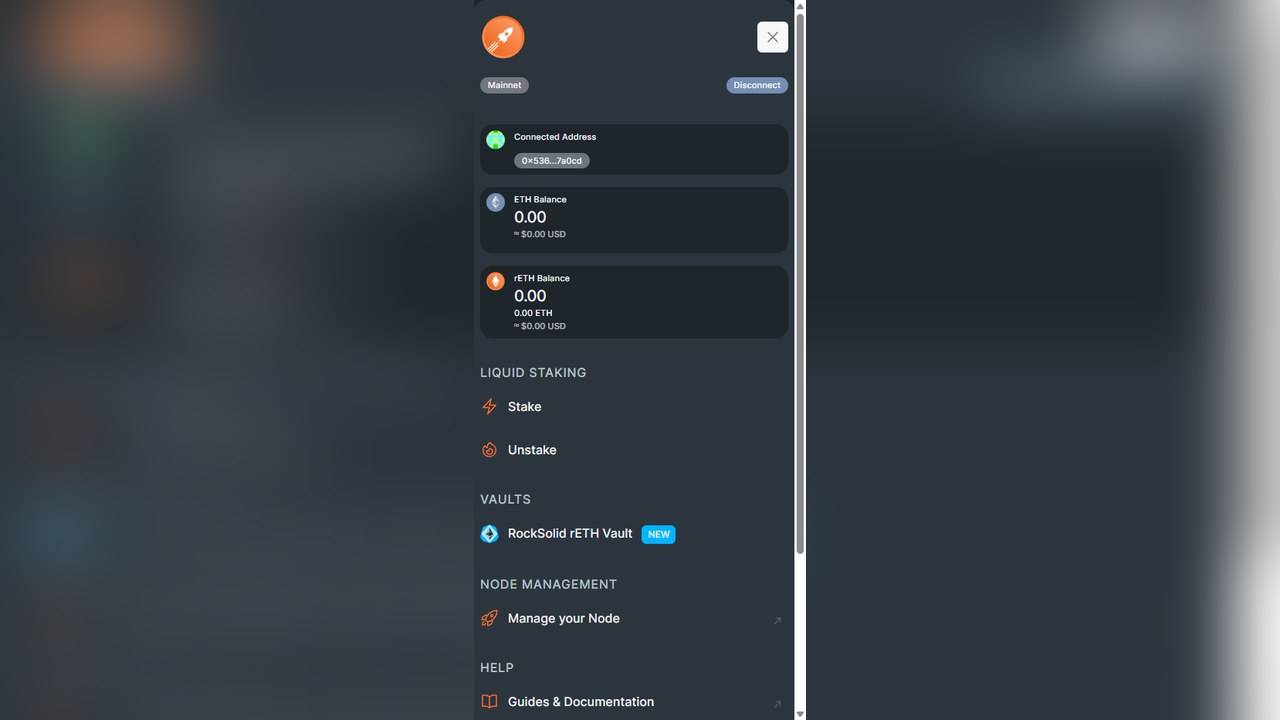
The app menu: it shows a Mainnet badge, a Disconnect button, your connected address, ETH and rETH balances, and links to Stake, Unstake, the RockSolid vault, Manage your Node and Guides and Documentation. It is short and easy to follow. We did not see a transaction history page, a portfolio chart or a support chat inside the app.
Fees and Costs
| Cost | What we found |
|---|---|
| Deposit fee | None shown in the app, the Transaction Cost row showed only gas |
| Protocol cut of rewards | The docs' default split sends 5% to node operators, 9% to megapool RPL stakers and 0% to the treasury, leaving 86% for rETH holders |
| Gas | Paid in ETH on mainnet, shown as "Low" at the time of testing |
| Unstake via CoW Swap | Gasless for you, but the quote was about 0.11% below the protocol rate in our sample |
| RockSolid vault | Fees not reviewed |
Tax note from the docs: depositing ETH may be a taxable event in some countries, while holding rETH usually creates no taxable event because the number of tokens stays constant. Tax rules differ by country, so check with a professional.
Security and Track Record
Audits. The docs say Saturn 1 "has undergone multiple rounds" of audits and link final reports from Cantina, Bailsec and Sigma Prime. For the earlier Houston upgrade the docs list Consensys Diligence (November to December 2023), Sigma Prime twice (November 2023 and March 2024) and Chainsafe (January to April 2024). The original launch was audited by Sigma Prime and ConsenSys Diligence, and DefiLlama also links a Trail of Bits report. Rocket Pool runs an Immunefi bug bounty with rewards up to $150,000 for critical bugs. We counted these from the docs and did not read the PDF reports ourselves.
Track record. DefiLlama's hack database lists one entry for Rocket Pool, dated 28 March 2023, for about $3.8M, labelled social engineering and phishing. The detail we found is that a large RPL holder was phished and lost 85,900 RPL. That was not an exploit of the protocol's contracts, but it is a reminder that holders, not only code, can be targeted.
| Risk | Plain explanation | How serious |
|---|---|---|
| Exit liquidity | The protocol has 0 ETH available for instant redemption, so you depend on a market route | Medium to high |
| Smart contract risk | New designs like Saturn 1 carry bug risk even after audits | Medium |
| Smaller size | About 5% of Lido, so fewer apps and less depth | Medium |
| Lower yield | 1.83% today, and 86% of validator rewards reach rETH by default | Low to medium |
| Third-party vault | RockSolid is separate and we did not review its strategy | Medium |
| RPL price | Down 61% in a year, thin trading volume | High for RPL holders |
| Slashing | Node operators can lose part of their bond, and the design aims to shield rETH holders (not tested by us) | Low to medium |
If you hold rETH in the same wallet that you use for random websites, one wrong approval can drain it. A separate wallet, or a hardware wallet, is the safest setup for long-term holdings.
Rocket Pool vs Competitors
TVL figures are from DefiLlama on 16 November 2026 (category Liquid Staking). TVL is a size measure, not a quality measure.
| Protocol | TVL | How it differs |
|---|---|---|
| Lido | $17.69B | Largest liquid staking protocol, about 20 times Rocket Pool's size |
| Binance staked ETH | $6.98B | Run by an exchange, so custody sits with a company |
| ether.fi | $3.42B | Liquid staking and restaking focused |
| Rocket Pool | $868M | Decentralised node operators, 4 ETH bond under Saturn 1, rETH exchange-rate token |
| StakeWise V3 | $711M | Vault-based staking, similar in size |
| Coinbase wrapped staked ETH | $363M | Exchange-issued token, custody with Coinbase |
| Stader | $140M | Smaller liquid staking protocol |
| Frax Ether | $89M | Part of the Frax ecosystem |
| Swell | $19M | Much smaller |
Rocket Pool is roughly 5% of Lido by TVL. The size gap means Lido's token is accepted in more places, while Rocket Pool's main selling point is how widely its validators are spread.
Pros and Cons
Pros
- Stake from 0.01 ETH with no lock-up on your side and no server to run.
- Run a validator with a 4 ETH bond under Saturn 1, far less than 32 ETH.
- rETH is a simple exchange-rate token with a clear price on CoinGecko.
- Multiple audits from named firms (Cantina, Bailsec, Sigma Prime for Saturn 1) and a bounty of up to $150,000.
- Clean, readable app that works on desktop, tablet and phone.
- The app is open about its own weak spot: the footer shows the 0 ETH exit liquidity.
Cons
- The protocol has 0 ETH of instant exit liquidity, so you depend on a market route.
- Plain staking yield is low (1.83% APR in the app today).
- About 5% of Lido, so fewer integrations and thinner markets.
- RPL has fallen about 61% in a year and trades thinly.
- The extra-yield vault is run by a third party and we did not review its strategy.
- Node running is technical and a real commitment.
Who Should Use Rocket Pool
- A beginner with ETH who wants to stake: reasonable fit. Start with a small amount, read the unstake section first, and use a wallet you keep secure.
- A long-term ETH holder who values decentralisation: a strong fit, with the size and liquidity caveats above.
- A technical home staker: the 4 ETH bond is the main attraction, but read the node docs carefully.
- Someone chasing the highest yield: probably not. Plain rETH yields little, and the vault adds risk.
- A trader of RPL: only with money you can afford to lose.
Verdict: 4.0 / 5
Rocket Pool does what it says and keeps the idea simple. The app is tidy, the numbers on screen match third-party data, the audit list is long and the 4 ETH node design is a real step toward letting normal people run validators. It loses points for the 0 ETH of instant exit liquidity, the small size next to Lido, a low headline yield and the thin RPL market. We could not test deposits, withdrawals, the vault or running a node, so this score reflects what we could see and read, not a full financial test.
Frequently Asked Questions
Is Rocket Pool safe?
It is audited and has run for years, and DefiLlama lists no exploit of its contracts. The one hack entry is a phishing loss of a large RPL holder in 2023. No staking protocol is risk-free, because of smart contract bugs, market risk and slashing.
What is rETH?
A token that represents your staked ETH plus rewards. Your rETH balance stays the same and each rETH becomes worth more ETH over time.
How much can I earn?
The app showed about 1.83% APR for liquid staking (7-day average) and the homepage shows 3.50% plus RPL rewards for node operators. The RockSolid vault showed 3.84% or more. These move over time and are not guaranteed.
Can I take my ETH out at any time?
You can sell rETH at any time through the CoW Swap route we saw available. The protocol's own exit pool showed 0 ETH, so the price depends on the market.
How much ETH do I need to run a node?
Under Saturn 1 the docs say a 4 ETH bond per validator, with 28 ETH provided by the pool.
Do I need RPL to stake?
No. Normal liquid staking needs only ETH. RPL matters for node operators and governance.
Is the RockSolid vault part of Rocket Pool?
No. It is reached from the Rocket Pool app but run by RockSolid, a separate company.
Is there a mobile app?
We did not find one. The web app works in a phone browser.
Did you spend real money?
No. We used a throwaway wallet with no funds, connected it, and opened the pages. We did not sign, approve, deposit or unstake. Real deposit and withdrawal speed, gas, the vault and node setup are untested.
Quick Links
- Website: rocketpool.net
- Staking app: stake.rocketpool.net
- Node app: node.rocketpool.net
- Docs: docs.rocketpool.net
- Governance forum: dao.rocketpool.net
- RockSolid: rocksolid.network
- DefiLlama: defillama.com/protocol/rocket-pool
- CoinGecko: coingecko.com/en/coins/rocket-pool
Disclaimer
This guide is for information only and is not financial advice. Staking carries a risk of loss, including smart contract failure, market risk and slashing. Figures were captured on 16 November 2026 from Rocket Pool's websites, DefiLlama and CoinGecko and change constantly. Always verify the address of the site you are using.
Editorial credits
Checked by Kanalcoin QC Team before publishing on November 18, 2026 for headline accuracy, original value, factual consistency, authorship claims, review evidence and risk disclosure: our AI review system checks every article before it goes live, and our duty editor monitors it after publication. Report an error.
Kanalcoin uses AI for research, drafting and review. Our editorial team is responsible for every article and corrects or withdraws articles when needed. How we review.