






Editorial review: This article is for information only and is not financial advice. Crypto assets, DeFi strategies, lending, token prices, yields, smart contracts and product access can involve loss, volatility and eligibility risks.
Who this guide is for: People who hold ETH or stablecoins and want to know what ether.fi is today (it started as liquid staking and now presents itself as a neobank), and anyone considering the ETHFI token.
What we tested (5 Nov 2026): The public site ether.fi (home, Personal/Cash, Business, Earn, ETHFI pages), the signed-out dashboard that opens from "Open App", the docs (welcome and Security & Risks pages), DeFiLlama and CoinMarketCap. Screenshots were taken at desktop 1440×900, tablet 1024×1366 and phone 430×932.
What we did NOT test: We did not sign in, open an account, pass KYC, deposit, stake, order a card or spend anything. Everything behind sign-in is marked (Not verified). Items from our earlier version of this article are labeled "older research".
What ether.fi is, in plain English
ether.fi describes itself as a non-custodial crypto neobank: one account to hold crypto, stocks and metals, earn yield, borrow, spend with a Visa Cash card, and send money. The staking roots remain: you can stake ETH and get weETH or eETH. Our docs capture lists five products: Card, Markets, Borrow, Earn and Stake.
Background: who built ether.fi and how it got here
We could not independently verify ether.fi’s founding, leadership, launch, airdrop, product-history, token-holder or funding claims for this review. The sections below focus on features and data observed on 5 Nov 2026.
The plain-English analogy
Think of ether.fi as a bank branch built on top of a savings engine. The engine is Ethereum staking: you lend your ETH to the network's security system and get paid for it. A normal staking service makes you lock up ETH and wait. ether.fi gives you a receipt token (eETH or weETH) that you can still move, swap or use as collateral while the original ETH keeps earning. The newer "neobank" layer then adds the things a bank gives you: a card, a cash balance, loans and transfers.
eETH, weETH and ETHFI: three tokens, three jobs
| Token | What it is | Why you would hold it |
|---|---|---|
| eETH | The receipt for ETH you staked. Its balance grows over time | Simple staking inside the ether.fi app |
| weETH | A wrapped version of eETH. The balance stays the same and each token becomes worth more ETH | The version most DeFi apps accept, so it is the one used on other chains and in lending markets |
| ETHFI | The governance token | Voting on treasury and product decisions; staking it unlocks membership levels (see the ETHFI page above) |
If you only want yield, you care about weETH or a vault. If you want a say in the protocol, you look at ETHFI. Do not mix the two: ETHFI is a market-priced token and can go down even while weETH keeps earning.
Tokenomics at a glance
From the CoinMarketCap capture: 965.35M ETHFI circulating out of 1B total and max supply, a market cap near $575M and an FDV near $595M. With almost all supply already circulating, the risk of big new unlocks is smaller than for many young tokens. The older version of this article mentioned ongoing investor vesting; we could not confirm the current schedule, so check the official docs before you decide. DeFiLlama also shows $79.84M of ETHFI staked (13.27% of market cap), which means a meaningful share of holders chose the voting and membership route.
Live numbers (5 Nov 2026)
| Metric | Value | Source |
|---|---|---|
| Total value locked | $5.036B | DeFiLlama |
| Fees, 30 days | $12.38M | DeFiLlama |
| Revenue, 30 days | $3.85M | DeFiLlama |
| Earnings (annualized) | $43.82M | DeFiLlama |
| Active loans | $47.81M | DeFiLlama |
| DEX volume, 30 days | $139.06M | DeFiLlama |
| Total raised | $32.3M | DeFiLlama |
| ETHFI price | $0.60 (DeFiLlama) / $0.5954, +1.65% 24h (CMC) | DeFiLlama, CoinMarketCap |
| Market cap | $595.77M (DeFiLlama) / $574.79M (CMC) | both |
| FDV | $595.42M (CMC) | CoinMarketCap |
| CMC rank | #79 | CoinMarketCap |
| Supply | 965.35M circulating, 1B total and max | CoinMarketCap |
| Holders | 136.62K | CoinMarketCap |
| CertiK rating | 3.9 | CoinMarketCap |
| Staked ETHFI | $79.84M (13.27% of market cap) | DeFiLlama |
The old article said $5.6B TVL. Today DeFiLlama shows $5.036B, and the chart shows TVL well below its earlier peak.
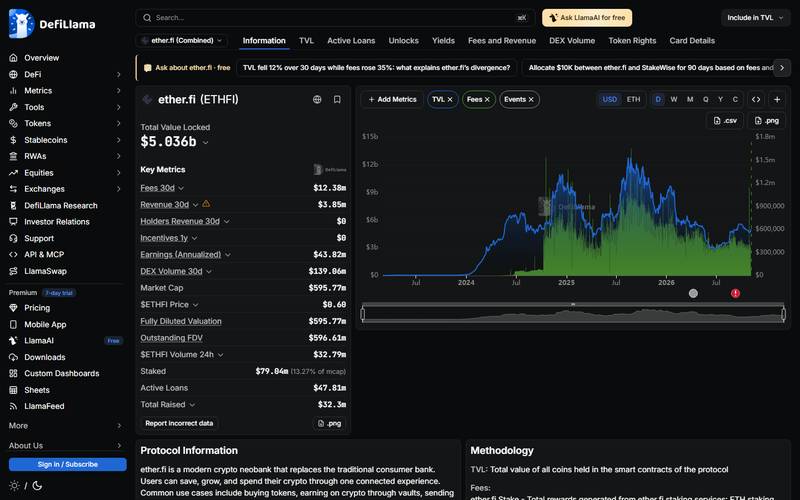
DeFiLlama: the chart shows TVL (blue) and fees (green).
What you see: The page describes ether.fi as a crypto neobank.

CoinMarketCap: ETHFI at $0.5954, rank #79.
What you see: The CoinMarketCap page for ETHFI on 5 Nov 2026 shows a price of $0.5954, a 24h change of +1.65% and rank #79. I use it to cross-check the DeFiLlama numbers: market cap near $575M, 965.35M ETHFI circulating out of 1B and 136.62K holders.
How to read the TVL and revenue numbers
TVL (total value locked) is the dollar value of assets that users have placed in the protocol. DeFiLlama shows $5.036B. That number moves with the ETH price, so a drop in TVL does not always mean users left. The more useful signals are fees ($12.38M in 30 days) and revenue ($3.85M in 30 days): fees are what users pay in total, revenue is the part that stays with the protocol. Annualized earnings of $43.82M and active loans of $47.81M tell us the borrowing side is small compared with staking. In other words, ether.fi is still mostly a staking business that is adding bank features on top.
How ether.fi looks on your device

Desktop (1440×900): "Be smart money".
What you see: Menu: Personal, Business, Earn, Staking, plus Open App. A cookie box with Change Preferences and Accept All covers the lower right. Get Started and App Store / Google Play buttons are on the hero.

Tablet (1024×1366): same hero, still showing the full menu.
What you see: On a tablet the hero looks the same as on desktop and the full menu stays visible, so nothing is hidden behind a hamburger icon. Buttons keep their size, which makes the page easy to tap.

Phone (430×932): menu becomes a round hamburger button.
What you see: Phone (430×932): menu becomes a round hamburger button; Get Started is the single call to action.

Earn page on a phone.
What you see: Earn page on a phone: "Get more from your assets", with weETH 2.45% staked ETH and USD 4.75% APY.

Cash page on a phone, with the cookie box on top.
What you see: Cash page on a phone, with the cookie box on top: "Your financial life in one place", Open Account.
The landing page

Full-length homepage, for structure only.
What you see: This is the whole homepage in one tall capture. I include it only to show the order of sections from top to bottom; the later pictures zoom into each block so the text stays readable.
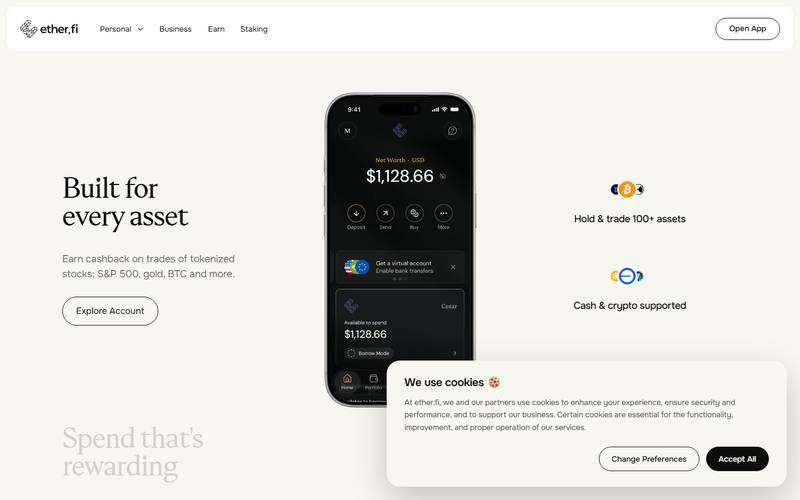
Built for every asset.
What you see: "Built for every asset": "Hold & trade 100+ assets" and "Cash & crypto supported". Phone mockup shows a net worth of $1,128.66 (demo data, not a real account).

Earn while holding.
What you see: "Earn while holding" rates: USD 4.75% APY, BTC 1.04%, ETH 3.4%, EUR 5.61%. Footnote: APY is variable and not guaranteed, and some vaults may not be available in all regions. The phone mockup shows weETH 2.56%, weETHs 2.56%, eBTC 0.53%, HYPE 3.96% and ETHFI 9.88%. These differ from the table, so mockup numbers are illustrative.

Trade with ease.
What you see: "Trade with ease": BTC $80,573, S&P 500 $771, Tesla $378, Gold $4,112 as sample prices, with a note that estimated rates are subject to volatility, slippage and network fees.
Core features
Personal / Cash

"Your financial life in one place".
What you see: Text: hold, earn, borrow, spend, trade and send from one account. Phone mockup shows a purple card with Manage, Card Details and Freeze Card, plus sample transactions (Uber -$20.54, Amazon -$64.20).
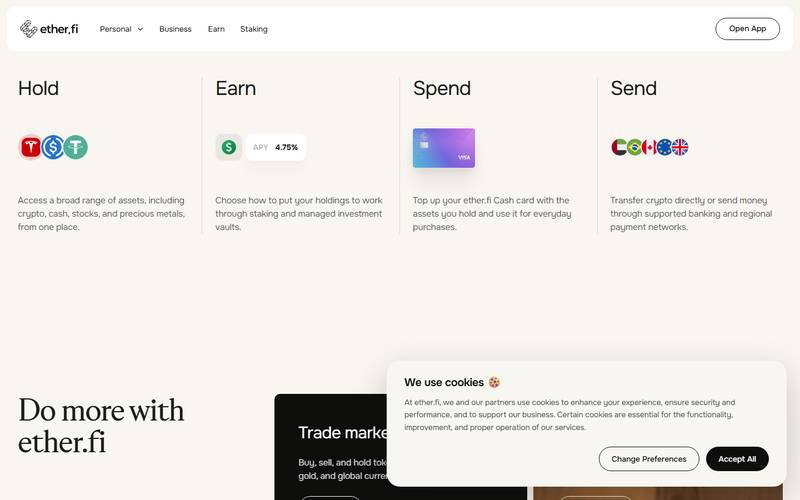
Hold Earn Spend Send.
What you see: Four columns: Hold (crypto, cash, stocks, precious metals), Earn (APY 4.75%), Spend (top up the Cash card with held assets) and Send (crypto or money through banking and regional payment networks).
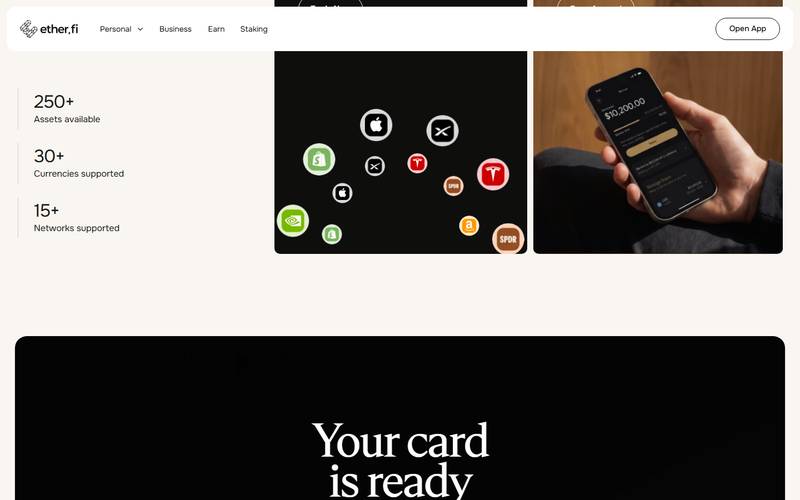
Stats on the page: 250+ assets, 30+ currencies, 15+ networks.
What you see: Below: "Your card is ready".
Earn (vaults)

"Get more from your assets": automated vaults, staking products and yield strategies.
What you see: Shown: weETH staked ETH 2.45% and USD 4.75% APY.
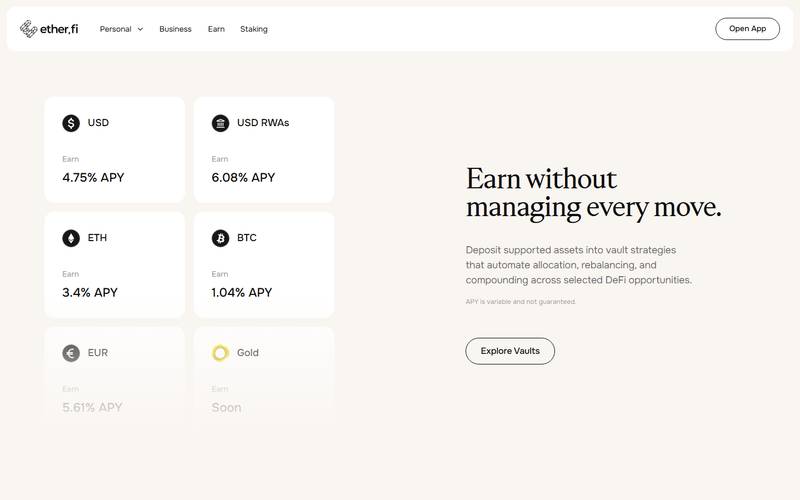
"Earn without managing every move".
What you see: "Earn without managing every move": vault cards for USD 4.75% APY, USD RWAs 6.08%, ETH 3.4%, BTC 1.04%, EUR 5.61%, and Gold marked "Soon". Button: Explore Vaults.

"Stake your assets and get rewards": weETH current APY 2.45% and weETHs 3.5%.
What you see: A note says redemption values may vary and APY is variable. "Protected by" lists Certora, Nethermind, Hypernative, Chaos Labs and Zellic. Infrastructure and custody partners: Chainnodes, Blockdaemon, Obol, stake.fish and ssv.network.
Business

"The platform for smart companies".
What you see: "The platform for smart companies" with an Open Account button and a desktop dashboard mockup. We did not find more detail in the capture.
ETHFI token

"Shape the future of ether.fi: stake ETHFI to vote".
What you see: Buttons: Stake ETHFI and Governance.
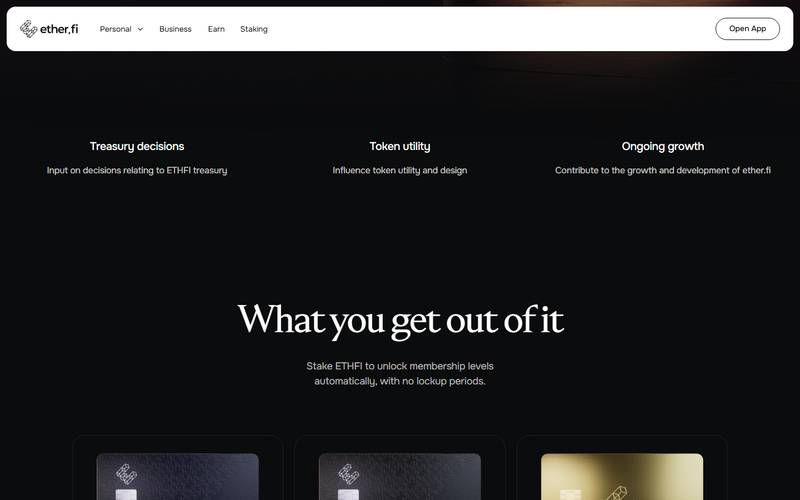
Voting covers treasury decisions, token utility and ongoing growth.
What you see: "Stake ETHFI to unlock membership levels automatically, with no lockup periods."
Some other URLs we guessed (for example /staking, /borrow, /markets, /card) returned "This page doesn't exist", so we did not use them.
The app (signed out)

Clicking Open App shows a dashboard with a left menu.
What you see: Clicking Open App shows a dashboard with a left menu: Home, Portfolio, Cards, Earn, Markets, Borrow, Transactions, Promotions, Travel, Refer & Earn. Home shows Portfolio Value with a Sign In button and Deposit, Send, Buy, Swap actions. A "Get the card" block says "Earn 3% cashback" with Verify Now. Other blocks: Assets (Add Funds), "Earn cash back on everything", "Buy stocks and more" and "Get a virtual account".
Fees
We found no fee table on the pages we captured, so we could not verify fees for the card, account, markets, borrowing, vaults or other products. We also could not verify supported countries, eligibility rules or product-access restrictions. The old article quoted card cashback and a $100 physical card complaint from Trustpilot. Those are older research and not verified. The signed-out app advertises 3% cashback in the Get the card block, but its terms, costs and eligibility were not verified.
How to use ether.fi: step-by-step tutorial
I opened the live ether.fi site and its web app in a clean browser on 5 November 2026 and clicked through every page I could reach without a login. I did not sign in, did not connect a wallet and did not deposit, so the actions that need an account are marked (Not verified). Note that ether.fi now presents itself as a money app ("Be smart money") and not only as a staking site.
Step 1: Start on the homepage
First, I type ether.fi into the address bar. The very first screen is a big "Be smart money" banner, not a staking box. That surprised me if you still think of ether.fi as a pure liquid-staking project.

ether.fi homepage with the Be smart money banner.
What you see: The homepage. The top menu reads Personal, Business, Earn and Staking, with an "Open App" button on the right. The banner says "Be smart money" and offers a Get Started button plus App Store and Google Play badges.
I use the top menu rather than the big button. Earn and Staking are the two entries that matter for yield.
Step 2: Read the Earn page
Next, I click Earn in the menu.
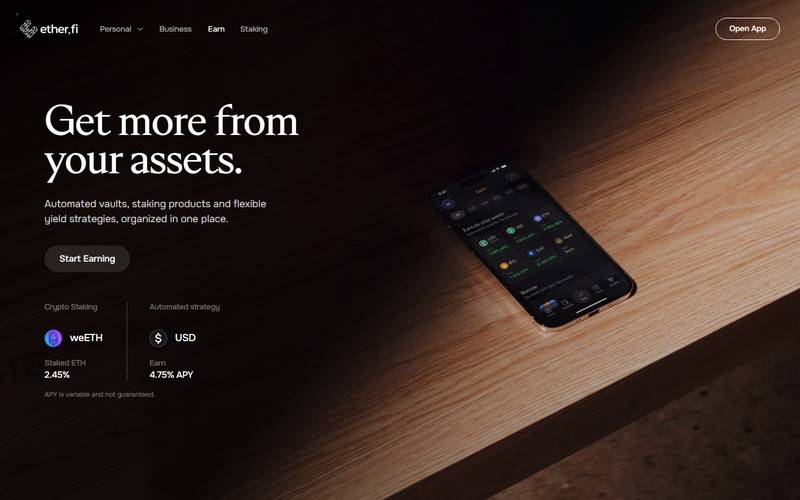
ether.fi Earn marketing page.
What you see: The Earn page: "Get more from your assets". A "Start Earning" button sits under the headline. At the bottom, two cards: Crypto Staking with weETH at 2.45% staked ETH, and an Automated strategy in USD at 4.75% APY. A note says APY is variable and not guaranteed.
I note two things. The staking number (2.45%) is a floating rate, and the USD strategy is a different product from the old ETH staking.
Step 3: Open the app
After that, I press Open App, which takes me to the member app.

ether.fi app home before sign-in.
What you see: The app home in a signed-out state. The left menu lists Home, Portfolio, Cards, Earn, Markets, Borrow, Transactions, Promotions, Travel and Refer & Earn. The main card shows "Portfolio Value: USD" with a Sign In button and quick actions Deposit, Send, Buy and Swap. Below are "Get the card" (3% cashback), an Assets box with Add Funds, and a stock-buying tile.
The app is built like a bank app, with a card and a virtual account next to the crypto features. If you only want staking, you can ignore most of it.
Step 4: See what Earn offers inside the app
Now I click Earn in the left menu.
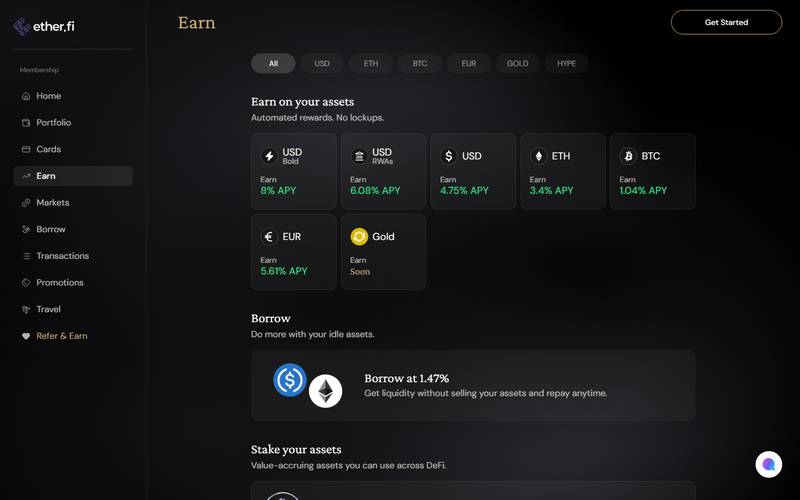
ether.fi app Earn page with APY tiles.
What you see: The in-app Earn page with filters All, USD, ETH, BTC, EUR, GOLD and HYPE. Tiles show USD (Bold) at 8% APY, USD (RWAs) at 6.08%, USD at 4.75%, ETH at 3.4%, BTC at 1.04% and EUR at 5.61%. Gold says "Soon". Under it are a "Borrow at 1.47%" banner and a "Stake your assets" section.
Which option should I pick? The highest tile (USD Bold at 8%) is not automatically the best. A higher rate usually means a more complex strategy behind it. For a first try, I would look at the ETH tile and read what it is built on before I put money in.
Step 5: Check the Markets page
Then I open Markets.
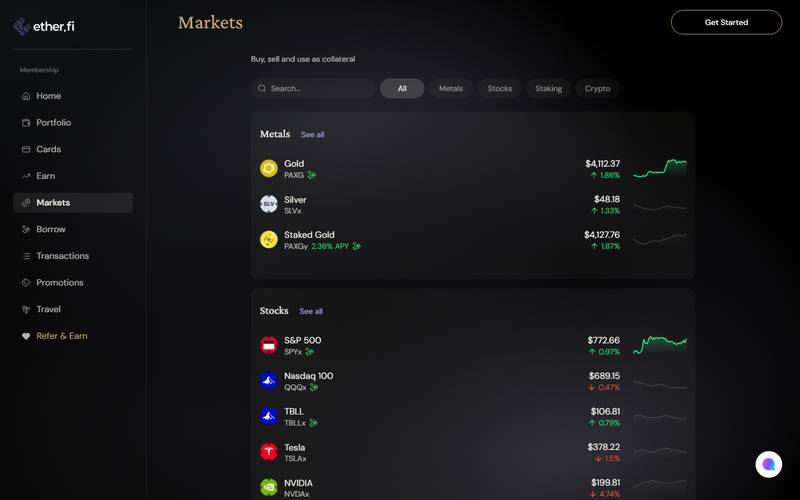
ether.fi Markets page.
What you see: The Markets page, "Buy, sell and use as collateral". Filters: All, Metals, Stocks, Staking and Crypto. Metals list Gold (PAXG) at about $4,112, Silver and Staked Gold. Stocks list S&P 500, Nasdaq 100, TBLL, Tesla and NVIDIA with prices and small charts.
This is where ether.fi differs most from a staking site. The same app lets you hold tokenized stocks and gold and use them as collateral.
Step 6: Look at the Borrow page
Next comes Borrow.
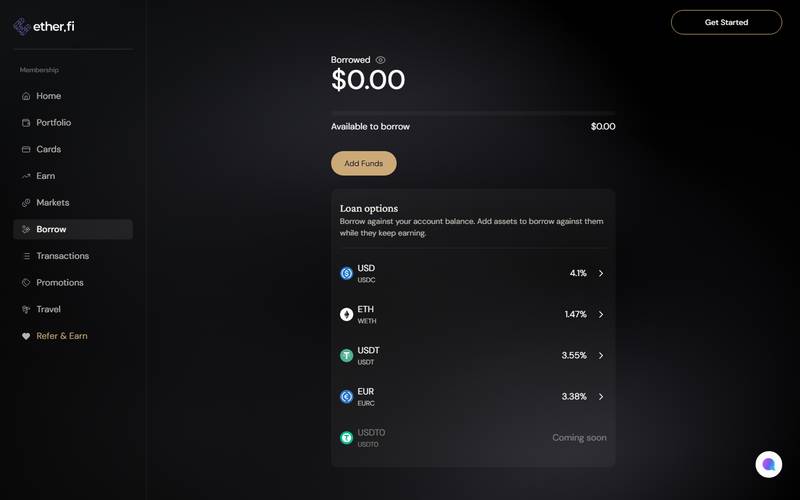
ether.fi Borrow page with loan options.
What you see: The Borrow page. It shows Borrowed $0.00, Available to borrow $0.00 and an Add Funds button. "Loan options" list USD (USDC) at 4.1%, ETH (WETH) at 1.47%, USDT at 3.55% and EUR (EURC) at 3.38%. USDTO says "Coming soon".
Because my balance is zero, the page shows nothing to borrow. Rates differ a lot between assets, so I would compare them before choosing which one to borrow.
Step 7: Try to deposit (signed out)
Finally, I press Deposit on the home screen to see what happens without an account.

ether.fi Become a Member prompt.
What you see: A "Become a Member" window appears over a blurred app. It says to sign in to get access to credit cards, personal finance services and membership rewards, and has a single Sign In button.
So you cannot deposit without an account. The steps after this point are (Not verified):
- Press Sign In and create or link an account.
- Choose Add Funds and pick a source (a crypto deposit or a fiat route).
- Pick the product on the Earn page and confirm.
- Check Portfolio and Transactions afterward.
Which option should I pick? Start with a small amount, and check the withdrawal page of the product before you deposit. I could not test withdrawals.
Referral
The app menu has a "Refer & Earn" entry. We did not open it. (Not verified)
Security

Docs: "Welcome to ether.fi", described as a non-custodial crypto neobank.
What you see: Products: Card, Markets, Borrow, Earn, Stake.

"Security & Risks".
What you see: "Security & Risks": the docs say the protocol is non-custodial, audited, and governed by multisigs with published signer configurations. Sections: Audits, MultiSigs & Controls, Slashing Risk, Active Defense, Incident Management.
We did not read the audit reports themselves. (Not verified)
Security, audits and risks
The docs "Security & Risks" page again, for reference.
What you see: I opened the Security & Risks page of the docs a second time to read the risk wording once more. If you plan to deposit, read this page first; it is the place where the team lists smart-contract and operational risks in its own words.
The docs list five areas: audits, multisigs and controls, slashing risk, active defense and incident management. The "Protected by" block on the Earn page names Certora, Nethermind, Hypernative, Chaos Labs and Zellic. We did not read the audit reports, so treat the names as a signal of effort, not proof of safety.
What can go wrong, in plain words:
- Smart contract risk. Your money sits in contracts. A bug in ether.fi, or in a protocol it connects to, can cause losses. More layers (vaults, restaking, borrowing) mean more places for a bug.
- Slashing risk. Restaked ETH can be penalized if a validator or a service it secures misbehaves. The docs have a dedicated slashing section, which is a good sign, but the risk exists.
- Depeg and exit risk. weETH should trade close to the value of the ETH behind it. In a market panic the price on exchanges can drift lower, and withdrawals from the protocol can take time.
- Rate risk. All APYs on the site are variable and not guaranteed. The footnote on the landing page says so.
- Token risk. ETHFI is a separate asset. It is down heavily from its early highs in the older research and can keep moving independently of staking yield.
- Neobank and regulatory risk. Card, KYC and bank-style transfers depend on partners and local rules. Some vaults may not be available in all regions, as the footnote says.
Our older research found no major exploit of the core staking contracts. We did not re-check this on 5 Nov 2026, so search for recent incident reports before you deposit a large amount.
Competitors
Older research, not re-checked, and shown without numbers on purpose.
| Feature | ether.fi | Lido | Rocket Pool | Kelp DAO |
|---|---|---|---|---|
| Main job | Staking, restaking, neobank | Liquid staking | Decentralized liquid staking | Liquid restaking |
| Receipt token | eETH / weETH | stETH / wstETH | rETH | rsETH |
| Restaking | Yes | No | No | Yes |
| Card and bank features | Yes (Cash card) | No | No | No |
| Best for | Users who want one app for yield and spending | Users who want the largest, simplest staking token | Users who care about small node operators | Users who want restaking only |
Comparison limitation: This older-research comparison was not re-checked, so it should not be used as a product recommendation. Check each provider’s current fees, eligibility, supported countries and product terms before choosing.
Who should use ether.fi, and who should not
- Good fit: ETH holders who plan to hold for months, want some yield, and are comfortable with DeFi wallets and a few extra layers of risk.
- Good fit: People who already hold crypto and want to spend it with a card instead of selling first.
- Poor fit: Beginners who have never moved ETH between wallets. Start with a small test amount.
- Poor fit: Anyone who needs to withdraw instantly or cannot accept variable yield.
Pros and cons
| Pros | Cons |
|---|---|
| One interface for staking, vaults, trading and a card | Everything beyond the landing pages needs an account |
| Security docs with named auditors and multisig info | TVL and token price are well below earlier peaks |
| Clear vault rates with an APY disclaimer | Rates differ between pages and the mockups |
| Non-custodial claim in the docs | Some guessed URLs returned 404 |
FAQ
Is ether.fi safe? It is non-custodial according to its docs and lists named auditors, but no DeFi protocol is risk-free. Contract bugs, slashing and market stress are real. Start small.
What is the difference between eETH and weETH? eETH grows in balance; weETH keeps the same balance and rises in value per token. Most other apps use weETH.
Is the APY guaranteed? No. The site says APY is variable and not guaranteed. The numbers we saw (for example weETH 2.45% and USD vault 4.75%) are a snapshot on 5 Nov 2026.
Do I need KYC? The signed-out app shows a "Verify Now" button next to the card offer, which suggests identity checks for the card. We did not go through it, so we cannot say what is required for staking only.
Can I use ether.fi without the card? Yes. Staking and vaults are separate from Cash.
Why do the rates differ between pages? The landing mockup shows weETH 2.56% and ETHFI 9.88%, while the Earn page shows weETH 2.45%. Mockups are illustrative and rates update over time.
Is ETHFI a good buy? We do not give price advice. The token has governance utility and no lockup for membership staking, but price is volatile.
Where can I verify the numbers? DeFiLlama and CoinMarketCap pages are linked below and shown in the screenshots above.
Verdict
ether.fi has moved from a staking product to a full neobank pitch. The public pages and docs are clear, and the data looks healthy: $5.036B TVL and $12.38M in 30-day fees. We could not test onboarding, the card or vault deposits, so we do not rate them. Rating: 3.5/5 for what is visible, with the account flow unverified.
Quick links
- Website: https://ether.fi
- Docs: https://etherfi.gitbook.io/etherfi
- DeFiLlama: https://defillama.com/protocol/ether.fi
Not financial advice. APYs are variable. Do your own research.