


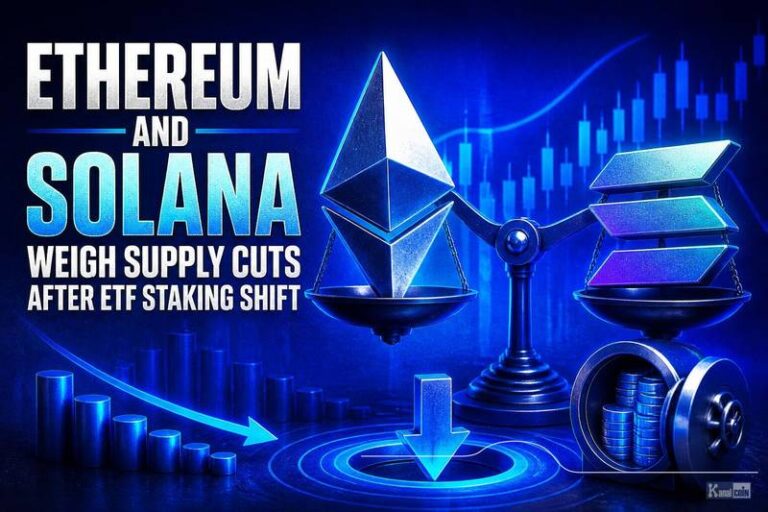
Wall Street has begun converting staking rewards into ETF cash distributions, repackaging crypto-native yield into a format traditional investors already understand, and that shift is fueling a debate over whether Ethereum and Solana should rethink how much new supply they issue.
TLDR KEYPOINTS
- Staking rewards are being turned into ETF cash distributions, giving mainstream investors a familiar income format.
- The change puts fresh scrutiny on how much Ethereum and Solana issue in new tokens.
- Reported discussions center on shrinking issuance, not cutting existing total supply.
Why ETF cash distributions change the staking narrative
Staking rewards are traditionally paid out on-chain in the network’s native token, accruing to validators and delegators who lock up assets to secure the network. Products such as the REX-Osprey staking ETF instead route that yield to shareholders as periodic cash distributions. For related coverage, see XRP vs. Ethereum: Why Spot ETF Investors Are Shifting Capital.
The packaging matters. A cash distribution is directly comparable to a dividend or a bond coupon, which lets traditional investors measure staking income against other yield products without touching a wallet or a validator. For related coverage, see Best Crypto to Invest in Now: Cold Wallet, Uniswap, Solana & XRP.
That legibility can change how markets value staking-based returns. When yield arrives as a token-denominated reward, its real value is entangled with issuance and inflation; when it arrives as cash, the underlying token economics become easier to scrutinize, as CryptoSlate reported. For related coverage, see Cboe Seeks SEC Approval for 3x Bitcoin and Ethereum Futures ETFs.
Why Ethereum and Solana could face pressure to shrink issuance
The clearest signal in the current discussion is that Ethereum and Solana are weighing whether to shrink issuance, the rate at which new tokens are minted, rather than reducing total supply that already exists. Ethereum’s ongoing issuance debate centers on exactly that tradeoff. For related coverage, see Best No-KYC Crypto Casinos Germany 2026: GlüNeuRStV, SEPA, and EUR Guide.
If staking yield becomes more transparent through ETFs, high token inflation is easier for investors to flag as dilution. That reframes emissions as a cost that competes directly with the appeal of the yield itself.
Lower issuance can support a scarcity narrative while preserving staking-linked income, but it also cuts the raw rewards paid to validators. The two networks face the same core tension between rewarding stakers and limiting dilution, a question that grows louder as regulated products bring in investors who move capital between spot ETF assets based on yield quality.
What this means for crypto investors
For investors, the shift creates a bridge between crypto-native yield and the income language of a traditional portfolio. A staking ETF distribution can sit alongside dividend and coupon income on a brokerage statement.
Any move to reduce issuance would sharpen the comparison between yield quality and dilution risk, since a headline staking rate means less when new supply is expanding quickly beneath it. This is why the debate matters beyond short-term price action.
The combination of regulated ETF access and tighter token economics could harden into a distinct institutional thesis, one that also frames how issuers position competing products such as leveraged crypto futures ETFs and tokenized funds built on Solana and Ethereum. The direction of that thesis will depend on decisions the networks have not yet finalized, and no confirmed issuance change appears in the latest fund disclosures.
Disclaimer: This article is for informational purposes only and does not constitute financial or investment advice. Cryptocurrency and digital asset markets carry significant risk. Always do your own research before making decisions.