


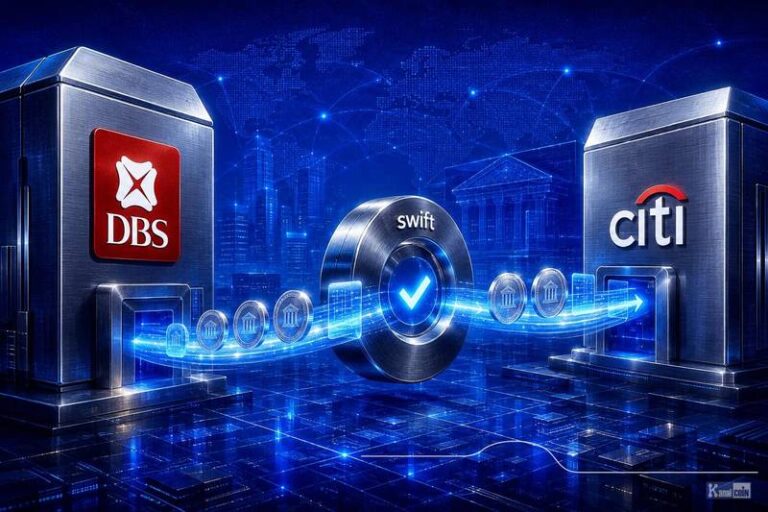
DBS and Citi have completed a cross-border US dollar payment using tokenized deposits on Swift’s blockchain ledger, a transaction carried out over a weekend. The DBS and Citi tokenized deposits payment links two of the banks most active across Southeast Asia to Swift’s experimental settlement infrastructure.
TLDR KEY POINTS
- DBS and Citi completed a cross-border USD payment.
- The payment took place over a weekend.
- It used tokenized deposits on Swift’s blockchain ledger.
DBS and Citi complete a cross-border USD payment on Swift’s blockchain ledger
The two banks completed a cross-border payment denominated in US dollars, moving value through tokenized deposits rather than a conventional correspondent-banking message, as reported by Crypto Briefing. Both DBS, headquartered in Singapore, and Citi run large regional operations across ASEAN markets. For related coverage, see AgriNext Awards & Conference Dubai 2026: Where Agriculture Leaders, Innovators and Investors Shape the Future of Food Systems.
What the reported payment involved
The reported elements are narrow: DBS, Citi, the US dollar, tokenized deposits, and Swift’s blockchain ledger. The available information does not assign a sending, receiving, issuing, or settlement role to either institution. For related coverage, see Mengenal Atlas System: Cara Kerja Smart Cycle, Dompet Web3, dan Transparansi On-Chain.
The transaction sits alongside other bank-led experiments on the same network, such as when HSBC and Standard Chartered ran a live Swift blockchain transaction. That context is relevant for Singapore, Hong Kong, and the wider region, where these lenders handle a large share of trade-linked dollar flows. For related coverage, see Ethereum Post-Quantum Signature Verification Cost Drops 6.6x.
Why the weekend timing matters
The payment was completed over a weekend, a detail worth noting because conventional cross-border settlement is often tied to weekday banking windows and correspondent cut-off times. Weekend execution speaks directly to the question of whether value can move outside standard operating hours.
What one weekend payment establishes
One reported weekend payment does not establish continuous 24/7 availability. A single completed transaction is not the same as a live, always-on service, and the available information does not confirm that the capability is repeatable or open to customers.
The reported completion should also not be read as independently verified final settlement. No timestamps, processing duration, operating schedule, or settlement-finality details are provided, so claims that the payment was instant, real-time, cheaper, or faster than another method cannot be supported here.
What remains unclear about the tokenized deposit payment
The supporting research adds no evidence beyond the headline, leaving several basic facts unconfirmed. This matters for regional readers weighing what tokenized bank money could mean for exchanges and settlement in markets such as Singapore, Manila, and Jakarta.
Transaction details and wider availability
The supplied information does not establish the payment amount, the exact date, the jurisdictions involved, the specific roles of each bank, or whether this was a test versus a live customer payment. Wider availability and repeatability remain open questions rather than confirmed next steps.
The phrase “tokenized deposits” here refers to bank-issued deposit money represented on a ledger, and should not be read as a public blockchain, a native crypto token, a stablecoin, or an investment opportunity. That distinction separates this bank-rail experiment from tokenization efforts in public markets, such as REC’s move to raise funds through tokenized bonds. For ASEAN exchanges and regulators, the near-term takeaway is a settlement-infrastructure signal, not a new tradable asset.
Additional source references: source document 1.
Disclaimer: This article is for informational purposes only and does not constitute financial or investment advice. Cryptocurrency and digital asset markets carry significant risk. Always do your own research before making decisions.