

TouristDigiPay is not yet publicly verifiable as a live service, so foreign tourists should not rely on it for crypto-funded merchant payments. The framework would convert supported crypto into baht through an approved operator and e-money partner, but no participating operator or customer-onboarding route has been publicly confirmed.
Users who qualify for an ordinary Thai exchange account can still trade, hold, deposit, and withdraw supported assets under that platform’s rules. This exchange access is independently visible, but it does not provide TouristDigiPay merchant spending or prove that a venue participates in the sandbox.
Separate a Thai payment pilot from live exchange access
A Thai payment pilot must be separated from normal exchange access because the permissions and money flows differ. The Thai SEC’s TouristDigiPay conditions require a licensed exchange, broker, or dealer, but a licence alone does not authorize the sandbox service.

The operator also needs TouristDigiPay approval, an agreement with a Bank of Thailand-regulated e-money provider, KYC controls, continuing reports, and an exit plan. None of those requirements can be inferred from an exchange licence, a bank partnership, or a merchant QR product.
TouristDigiPay status in August 2026
The SEC project conditions confirm who may apply and require paired operator and e-money accounts, but they do not publish an approval register, live onboarding route or supported-asset list. Coin selection remains with each participating operator, so none of those operational details can be inferred from the framework alone.
The timeline establishes a framework, not live availability. The SEC opened consultation on July 15, 2025, announced the sandbox on August 18, and made the participation rules effective on September 24. Applications then ran from September 25 to December 26, 2025. At the August 2026 verification point, those pages still did not identify a live operator, partner, asset list or onboarding path. KanalCoin’s original TouristDigiPay launch coverage is therefore announcement coverage, not current operator confirmation.
Thai exchange access that is independently visible
Thailand does have regulated exchange and broker access, but it solves a different job. The table separates what can be verified on ordinary product surfaces from TouristDigiPay approval, while a regional exchange liquidity and slippage test remains necessary before choosing a venue for execution.
| Brand and legal entity | Current Thai SEC licence | THB rail visible publicly | Crypto withdrawal visible publicly | TouristDigiPay approval |
|---|---|---|---|---|
| Bitkub — Bitkub Online Co., Ltd. | Exchange and broker | QR deposit and withdrawal to a Thai bank account | Supported assets have published deposit and withdrawal fees | Not publicly confirmed |
| Orbix — Orbix Trade Co., Ltd. | Exchange and broker | THB deposits and withdrawals to an approved bank account | Digital-asset deposits and withdrawals are included in its public terms | Not publicly confirmed |
| Binance TH — Gulf Binance Co., Ltd. | Exchange and broker | Local THB access is offered on the Thai product | A public crypto withdrawal fee schedule is available | Not publicly confirmed |
| Upbit Thailand — Upbit Exchange (Thailand) Co., Ltd. | Exchange and broker | Not confirmed from an accessible public product page | Not confirmed from an accessible public product page | Not publicly confirmed |
| InnovestX — InnovestX Securities Co., Ltd. | Broker only | Its digital-asset product describes a THB wallet and THB deposit/withdrawal | Its product page describes digital-asset deposit/withdrawal | Not publicly confirmed |
The licence classifications come from the Thai SEC digital-asset business list. Product access is supported by the public surfaces for Bitkub THB fees, Orbix terms, Binance TH crypto fees, and InnovestX digital assets; none of them is a substitute for a TouristDigiPay approval notice.
These five rows document ordinary Thai exchange or broker access only. They are not a list of approved TouristDigiPay providers, and appearing in the SEC licence register does not establish sandbox participation.
Eligibility can still decide the result when two platforms display similar markets. In a Thailand exchange-access discussion, a six-year Bitkub user said Binance TH was usable only when the required documents were available. Reviewed August 10, 2026, that comment describes Bitkub and Binance TH account access, not a TouristDigiPay transaction.
Follow the Thai user journey from funding to settlement
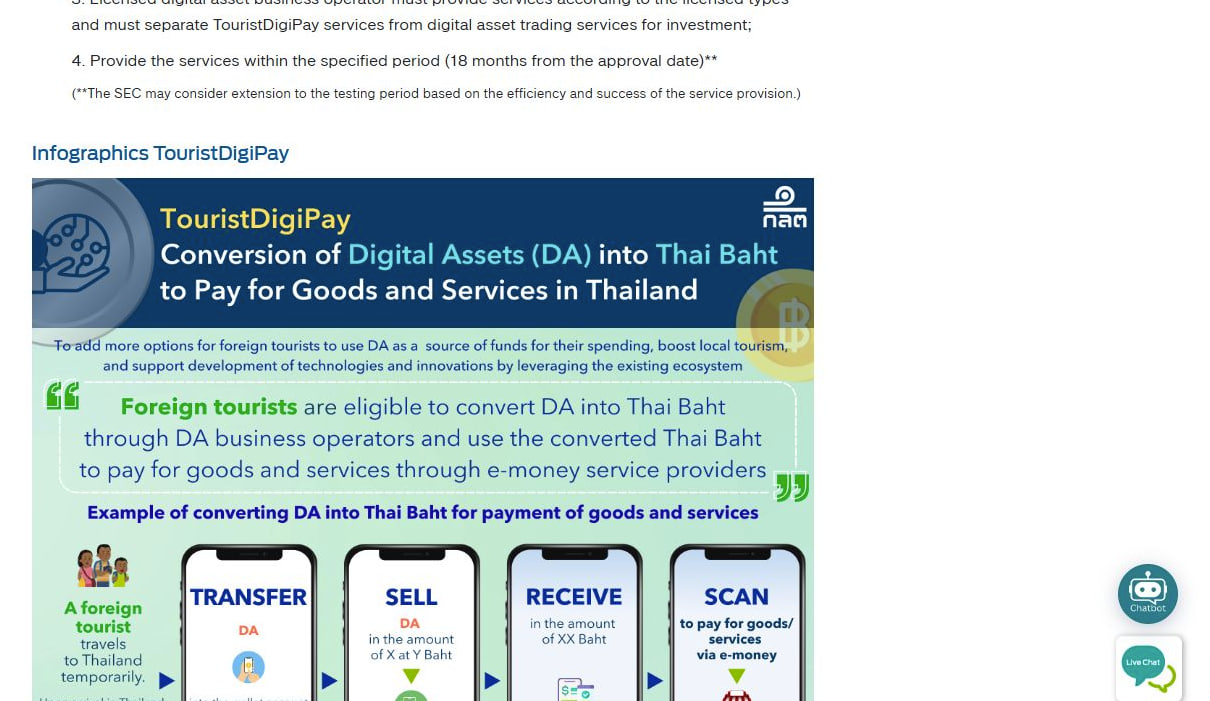
The Thai user journey runs through two linked providers rather than one crypto app. The digital asset operator handles the wallet transfer, screening, sale, and outbound conversion; the e-money provider receives THB and completes merchant payment. A missing handoff means the TouristDigiPay route is not complete.
Before relying on the route, a visitor would need to confirm:
- A passport and identity profile accepted by both the operator and e-money provider.
- Exactly matching legal names across the two customer accounts.
- Continued control of the original wallet for the permitted outbound conversion.
- An asset and blockchain network supported by the approved operator.
- A merchant QR type accepted by the connected e-money wallet.
TouristDigiPay versus standard exchange access
TouristDigiPay is a controlled spending route for eligible foreign tourists, whereas standard exchange access supports investment and asset management under ordinary account terms. The comparison must therefore cover user eligibility, provider structure, settlement destination, spending restrictions, and exit mechanics instead of treating both products as interchangeable crypto access.
| Decision point | TouristDigiPay sandbox | Standard exchange access |
|---|---|---|
| Primary user | Foreign tourist temporarily in Thailand | User eligible under the exchange’s ordinary account terms |
| Main purpose | Convert digital assets into THB for goods and services | Buy, sell, hold, trade, deposit, or withdraw supported assets |
| Required providers | SEC-approved exchange, broker, or dealer plus a connected e-money provider | Licensed exchange or other operator offering the chosen service |
| Inbound route | Asset moves to the operator’s assigned wallet, is sold at market price, and THB moves to the tourist’s same-name e-money account | Funding and asset route depend on the platform and account |
| Merchant receipt | Merchant receives THB through an electronic payment or QR route | Holding assets on an exchange does not create a merchant payment route |
| Asset availability | Participating operator chooses eligible assets under its selection criteria | Exchange listing and network support determine availability |
| Spending boundary | THB 50,000 per month at small Tag 29 merchants; THB 500,000 at KYM-verified Tag 30 merchants under the published sandbox framework | Trading, deposit, and withdrawal limits follow the platform and account tier |
| Exit route | Remaining THB can be converted back to digital assets and returned to the same wallet used for inbound transfer | Withdrawal may go to a supported wallet or bank route under ordinary product rules |
| Prohibited shortcut | No direct crypto payment, cash exchange, third-party THB transfer, or asset-to-asset trade inside the sandbox flow | Ordinary access does not automatically provide TouristDigiPay merchant spending |
The SEC’s TouristDigiPay FAQ limits merchant access to electronic THB payment and the applicable merchant-class spending cap; it does not create a cash-out counter. The sandbox prohibits cash exchange, person-to-person THB transfer and asset-to-asset trading. KanalCoin’s merchant crypto and stablecoin payment guide covers the separate controls a merchant needs outside this tourist flow.
Unused THB can be converted back into an eligible asset and returned to the same wallet used for the inbound transfer. The official FAQ does not publish an account-closure workflow, so closure timing and any residual-balance process beyond that outbound route remain not publicly confirmed.
The total cost is also not publicly confirmed without a named live provider and tariff. A usable quote must show the crypto-THB spread, operator fee, e-money wallet fee, inbound network fee, and the spread, fee, and network cost of converting unused baht back to crypto. Until those charges are published or tested, the route should not be described as free or cheaper than a card, cash exchange, or standard exchange withdrawal.
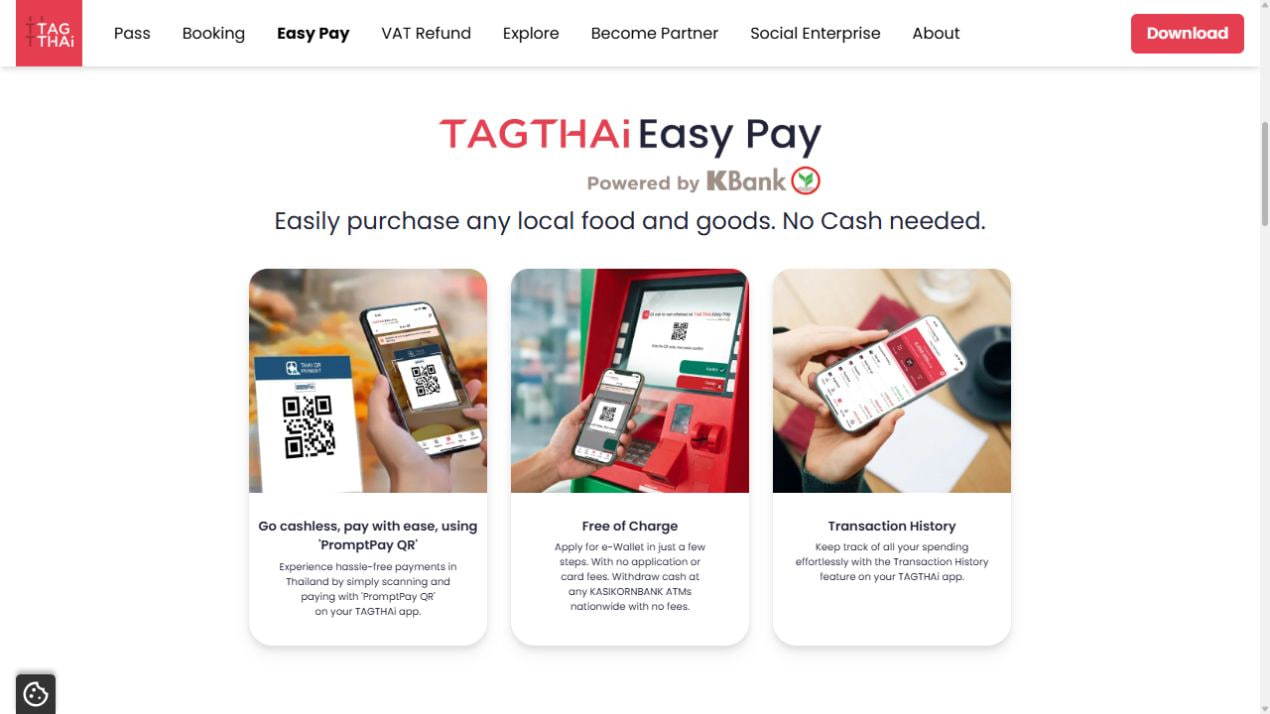
A TAGTHAi QR-payment walkthrough shows why the last step still needs testing. The traveller completed passport registration and cash loading at a KBank airport booth in about eight minutes, then activated the app with a prepaid-card identifier and six-digit payment PIN. The account setup was easier than finding a repeatable funding route.
During use, the same traveller found that a local SIM loaded the app reliably, some merchant QR codes failed, and later top-ups required another KBank FX booth visit. Reviewed August 10, 2026, the report does not test TouristDigiPay itself, but it exposes the practical e-money layer: connectivity, merchant QR type, and reload access can determine whether THB is spendable.
Same-name and same-wallet controls change recovery
Recovery requires the tourist, e-money account and original wallet to remain aligned. A companion’s account cannot replace the same-name account, and losing the original wallet can block the documented outbound route even when a THB balance remains visible. Record both legal entities, assigned wallet and support owner before funding because a blockchain confirmation cannot resolve an account-name mismatch.
Check THB settlement and consumer recovery
THB settlement and recovery depend on the handoff between the digital asset operator and e-money provider. The operator controls asset receipt, screening, sale, and outbound conversion; the e-money provider controls the baht balance and merchant payment. The receipt trail must cover both sides rather than only the blockchain transfer.
A low-value test should confirm that both accounts carry the same customer name and that the full route completes. Save the quote, conversion rate, THB credit, merchant confirmation, refund terms, and both support channels. A chain confirmation is not an e-money credit, merchant receipt, or completed refund.
Past success does not guarantee the next THB transfer. A Thailand bank-transfer discussion described repeated THB 1–5 million withdrawals from Binance and Bitkub without trouble, while a Bitkub account-freeze report recorded the opposite outcome after six months of verified exchange funding. Both were reviewed August 10, 2026.
That contrast moves the decision away from brand familiarity and toward transfer readiness. The account name, destination-bank policy, source-of-funds file and escalation route should be ready before the amount increases. These comments concern TAGTHAi, Bitkub, Binance TH and bank transfers; none records direct use of TouristDigiPay or establishes a universal Thai policy.
Worked example: a tourist plans to spend THB 80,000
A tourist planning to spend THB 80,000 must first match the budget to provider approval and merchant category. A KYM-verified hotel using Tag 30 can fall within the THB 500,000 monthly boundary, while small Tag 29 merchants remain subject to the lower THB 50,000 boundary.
The visitor must next confirm that an approved operator supports the asset, both accounts can be opened under matching names, and the intended merchant accepts the e-money route. Convert only enough for the first payment and verify the THB credit and receipt before increasing the amount.
If THB 20,000 remains, the visitor cannot use the sandbox as an ATM or transfer the balance to another person. The permitted exit converts it back into a supported asset and returns it to the original wallet. Wallet access, spread, network cost, and outbound screening therefore remain part of the trip cost.
Use TouristDigiPay only after a named route goes live
Use TouristDigiPay only after the SEC or a named operator confirms the approved legal entity, e-money partner, onboarding path, supported asset, full cost and outbound route. Until then, treat it as a documented sandbox framework rather than a customer-ready alternative to ordinary Thai exchange access.
Frequently asked questions
Does a Thai crypto payment pilot mean retail exchange access?
No. TouristDigiPay converts eligible tourists’ assets into THB for controlled e-money spending, while normal exchange access supports trading and withdrawal under separate account terms. Verify the approved operator, e-money partner, supported asset, funding route, and permitted exit before treating either service as available.
What should a merchant check before accepting a crypto-linked payment?
Merchants should verify that they receive THB, identify the e-money or acquiring route, and record settlement timing, reconciliation fields, refund ownership, and dispute support. Direct crypto acceptance is not the TouristDigiPay model, so the merchant test should begin with the actual QR and baht receipt.
Can a visitor use the same Thai crypto services as a resident?
Not automatically. TouristDigiPay targets eligible foreign tourists through paired operator and e-money accounts, while residents use ordinary regulated exchange routes. Identity rules, supported funding, bank access, spending permissions, and withdrawal options differ, so a Thai-facing brand does not guarantee the same product for both users.
Disclaimer: This article is for informational and editorial purposes only and does not constitute legal, tax, or financial advice. Terms, fees, supported countries, and onboarding requirements can change and should be confirmed with each provider before integration.