


Stablecoin remittance is not automatically cheaper in Southeast Asia. It wins only when the recipient receives more usable local currency after the purchase spread, network withdrawal, destination sale, bank payout, and any account-review delay are included.
The three corridors examined here produce different results. SGD-PHP changes winner as the transfer size rises, MYR-IDR favors Western Union in the displayed comparison, and SGD-THB cannot support a clean verdict until a payout-fee discrepancy is resolved.
The correct score is the amount credited to the recipient, not the gas fee or stablecoin amount shown in the sender’s wallet. Every handoff can remove value, including funding, trading, exchange withdrawal, destination conversion, local payout, and a failed-transfer recovery process.
Use one formula for both conventional and stablecoin routes:
Total cost % = (mid-market payout – actual recipient payout) / mid-market payout x 100
The mid-market payout is the sender amount converted at the reference FX rate without fees. The actual payout is the local currency the beneficiary can use after the route finishes. Comparing those two figures prevents a provider from advertising zero fees while recovering its margin through a weak exchange rate.
Evidence quality also changes the strength of the result. A provider quote shows what its public interface offered, a third-party market quote combines public prices and stated charges, and a funded execution proves what reached a real account. This article has the first two forms of evidence but does not claim a KanalCoin-funded transfer.
That distinction matters because Banca d’Italia’s 2026 mystery-shopping exercise executed transfers of 200 USDC across ten corridors and found total costs ranging from 0.30% to almost 9%. The onchain fee was marginal; domestic payment infrastructure determined much of the final cost and speed.
| Cost layer | Record before sending | Cost that can remain hidden | Stop condition |
|---|---|---|---|
| Funding and purchase | Sender debit, stablecoin received | Bank fee, card surcharge, trading spread | The executable amount is missing |
| Network transfer | Token, chain, withdrawal charge | Exchange fee can exceed gas | Recipient cannot accept that network |
| Destination sale | Local-currency proceeds | Thin liquidity or P2P premium | The full amount cannot be sold at the quote |
| Bank payout | Final credit and arrival window | Partner fee, limit, name mismatch | The beneficiary or bank is unsupported |
| Recovery | Hold, rejection, refund route | Time, support effort, FX movement | No accountable recovery owner exists |
The corridor determines the winner. RemitRoutes displayed the following market comparisons on August 20, 2026 for the same 1,000-unit sender amount. These are third-party route quotes assembled from public market and provider data, not transactions funded by KanalCoin, so they should be refreshed before publication or use.
| Corridor | Route and payout rail | Mid-market payout | Recipient gets | Cost and completion estimate |
|---|---|---|---|---|
| SGD to PHP | USDC on Polygon to Coins.ph, then PHP bank payout | 48,551.36 PHP | 48,226.13 PHP | 0.67%; platform-ready in about 15-30 minutes |
| SGD to PHP | Wise bank transfer | 48,551.36 PHP | 48,212.18 PHP | 0.70%; about four hours |
| MYR to IDR | Western Union bank transfer | 4,388,581.95 IDR | 4,378,933.33 IDR | 0.22%; one business day |
| MYR to IDR | USDC on Ethereum to the displayed Indodax route | 4,388,581.95 IDR | 4,347,046 IDR | 0.95%; bank-completion time unverified |
| SGD to THB | Wise bank transfer | 25,886.34 THB | 25,654.85 THB | 0.89%; one to two business days |
| SGD to THB | USDC on Stellar to the displayed Bitkub route | 25,886.34 THB | 25,639.25 THB | 0.96%; bank payout can take up to 24 hours |
The mid-market column makes each result reproducible with the formula above. The fee shown by the tool was S$6.50 for Coins.ph versus S$4.48 for Wise, RM9.06 for the displayed Indodax route versus RM2.22 for Western Union, and S$9.25 for Bitkub versus S$6.77 for Wise. Those values combine route assumptions and must not be presented as exchange fee schedules.
MYR-IDR gave a clearer result. Western Union delivered 31,887.33 IDR more than the displayed Indodax USDC route and reduced the measured cost by 0.73 percentage points. The stablecoin transfer could still be useful for a recipient who needs USDC rather than rupiah, but it did not win the cash-out comparison shown here.
The displayed Coins.ph route produced the highest PHP payout at 1,000 SGD, but its advantage was too small to support a broad winner claim. It required the sender to fund Kraken, buy USDC, withdraw on Polygon, sell into pesos, and complete the local payout. Wise presented the bank-transfer result in a more consolidated flow.
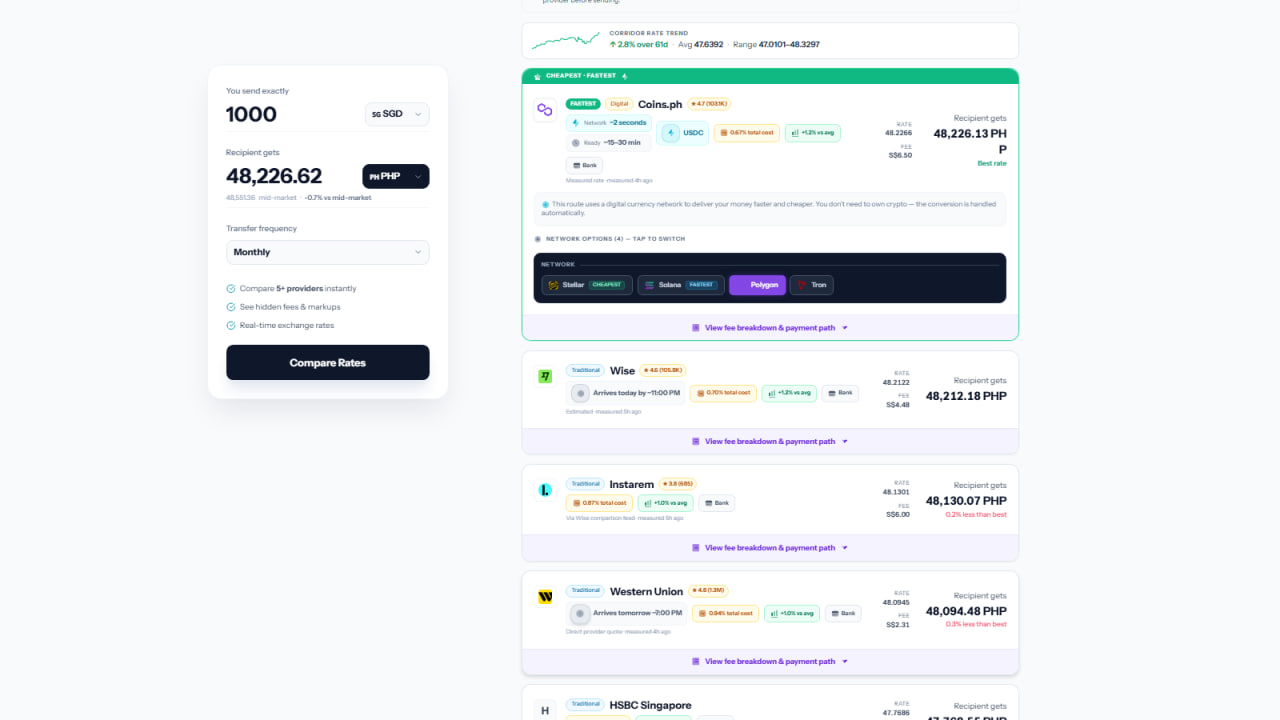
The comparison tool estimated 48,226.13 PHP through Coins.ph USDC on Polygon and 48,212.18 PHP through Wise. Coins.ph independently confirms native Polygon USDC deposits and a public USDC-PHP conversion surface. The Kraken SGD purchase price and the complete bank payout remain quote components rather than a funded KanalCoin execution.
Transfer size changes the order because fixed charges represent a larger share of a small payment:
- At 200 SGD, Wise displayed 9,642.44 PHP versus 9,638.55 PHP through Coins.ph.
- At 500 SGD, Wise displayed 24,106.09 PHP versus 24,097.11 PHP through Coins.ph.
- At 1,000 SGD, Coins.ph displayed 48,226.13 PHP versus 48,212.18 PHP through Wise.
- At 2,000 SGD, Coins.ph displayed 96,452.76 PHP versus 96,424.37 PHP through Wise.
The crossover occurs between 500 and 1,000 SGD in this snapshot, not across every market condition. The Southeast Asian liquidity and slippage guide explains why the displayed route still needs an order-size check before execution.
A historical Singapore-to-Philippines remittance discussion adds useful workflow evidence without establishing current pricing. A Singapore-based participant described sending DBS to Wise to BPI and reported that a 2022 simulation produced more pesos through Wise than a zero-fee DBS transfer because the exchange rate offset Wise’s dynamic fee.
That experience predates the current quotes and should not be used as a 2026 price claim. It does show why the fee label alone is insufficient: the recipient amount and bank-credit time decide the outcome. The sender should verify the same SGD amount on both routes immediately before transferring.
The displayed MYR-IDR result favored the conventional provider because the destination conversion outweighed the low-cost token transfer. Western Union showed 4,378,933.33 IDR for 1,000 MYR, while the Indodax USDC route showed 4,347,046 IDR after the Ethereum network and rupiah payout were included.
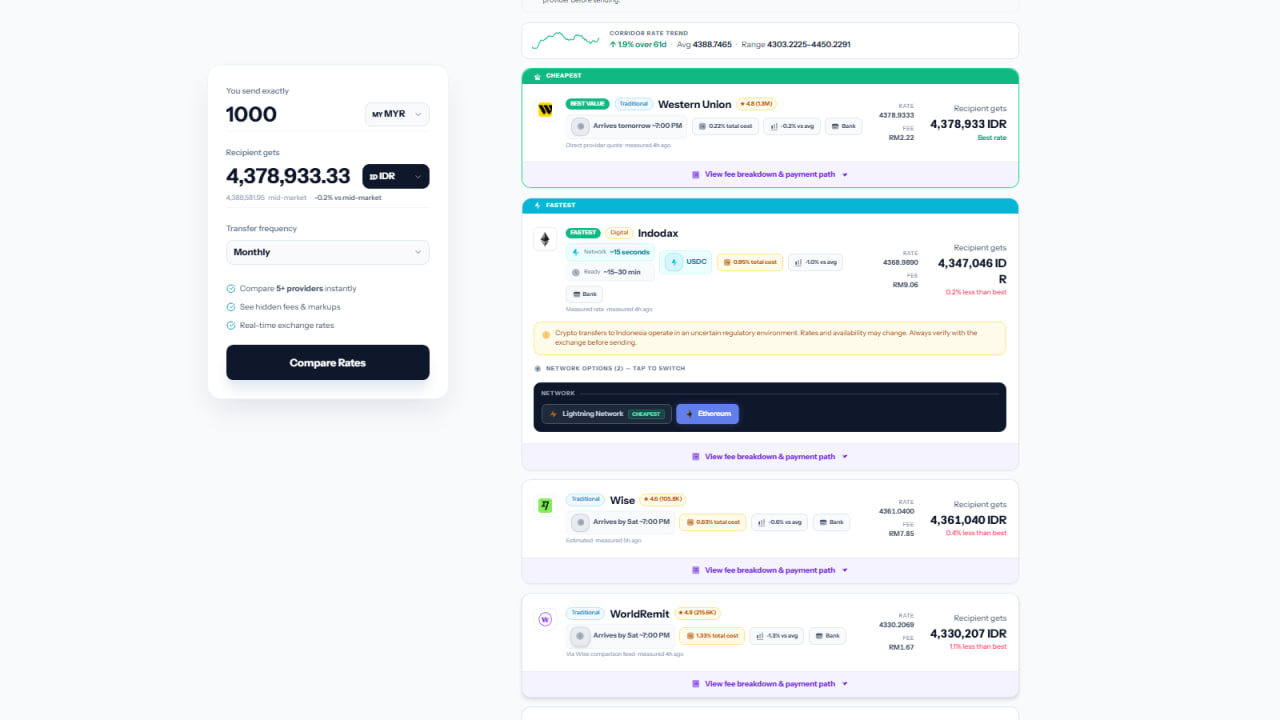
Ethereum was selected in the displayed USDC route. Indodax’s public USDC-IDR market confirms the destination pair, while its USDC network announcement states that deposits and withdrawals support ERC-20 alongside several other networks. These pages verify the components, but not the aggregator’s RM9.06 route cost or final bank-completion time.
A Malaysia-to-Indonesia currency discussion provides closer corridor evidence than the earlier reverse-direction P2P case. A participant who exchanges MYR and IDR frequently described rates in Malaysia and Indonesia as broadly similar, while others favored Wise or an Indonesian ATM for convenience.
The discussion concerns travel money rather than a funded remittance, so it cannot verify the Western Union or USDC quotes. It does support a practical conclusion: small rate differences can be outweighed by access, ATM, payout, and handling costs. The IDR onramp and withdrawal guide covers the local checks needed after arrival.
The displayed SGD-THB comparison placed Wise slightly ahead of Bitkub: 25,654.85 THB versus 25,639.25 THB from 1,000 SGD. That result cannot be treated as final because the aggregator modeled a 100 THB withdrawal charge, while Bitkub’s public withdrawal surface currently displays a 20 THB fee.
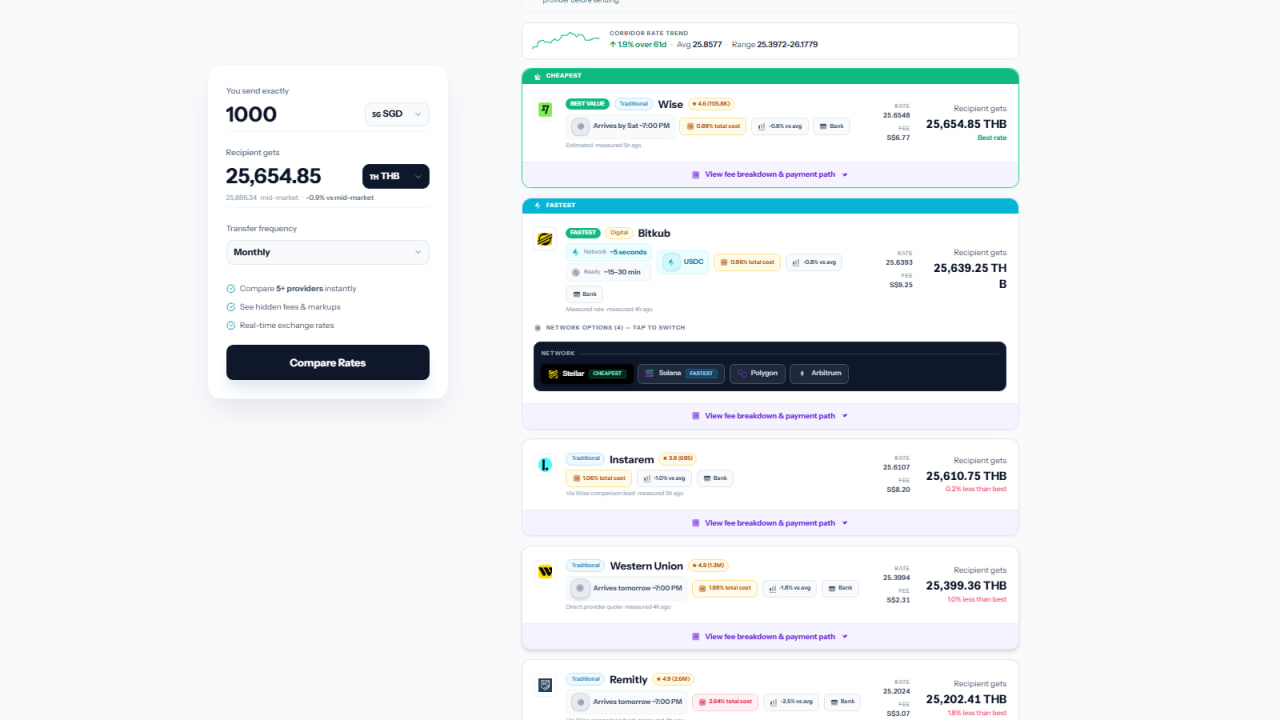
Bitkub publicly exposes a USDC-THB market, and its THB withdrawal page states that bank withdrawals can take up to 24 hours. Those pages confirm the local conversion and payout components, but they do not verify Stellar deposit compatibility. The network and fee conflict means the route must be rebuilt with a current logged-in quote before declaring Wise or Bitkub the winner.
Blockchain settlement is only the middle of a remittance. The recipient still depends on exchange confirmations, compliance review, sell-side liquidity, a withdrawal queue, and the receiving bank. A five-second network cannot compensate for a transfer held for several days.
A Coins.ph account-hold report illustrates that boundary. The account holder described an external transfer of more than 1,047 USDT on Tron that remained unavailable for about a week before the assets were returned after escalation and an alternate wallet was supplied.
This is one disputed account experience, not evidence that Coins.ph transfers normally fail. It belongs in the cost model because a held remittance can miss rent, payroll, or family-support deadlines even when its quoted spread is competitive. A first transfer should be small enough to confirm deposit, sale, withdrawal, and recovery access.
The asset label alone does not settle the route either. The choice between USDT and USDC begins with the exact token and network supported at both ends, then moves to executable liquidity and final bank payout. That keeps this cost test separate from a broader stablecoin comparison.
A recurring route should be recorded as a complete money path. Keep the sender account, amount debited, exchange fill, token, network, destination credit, local sale, bank payout, arrival time, and support reference in one ledger. A screenshot of the gas fee is not enough to reconstruct the payment.
The route must be rechecked whenever an exchange changes withdrawal fees, a bank partner changes, or the recipient moves to another account. KanalCoin’s guide to VND bank transfers, P2P, and stablecoin withdrawals demonstrates why a named cash-out path is more useful than a general claim that stablecoins work in a country.
Businesses should add two thresholds to the record: the minimum saving required to justify extra handoffs and the latest acceptable delivery time. A route saving 0.03 percentage points may not justify more operational work, while a larger saving can still fail the business case if the payout has no accountable recovery owner.
The same record improves tax and reconciliation work because the purchase, transfer, sale, and bank credit remain connected. It also exposes when a route that looked cheap at the first conversion became expensive at the destination spread or payout stage.
SGD-PHP changed winner with transfer size, MYR-IDR favored Western Union in the displayed comparison, and SGD-THB remained unresolved because two fee sources disagreed. These results support a corridor-by-corridor method rather than a universal verdict for stablecoins in Southeast Asia.
Proceed only when the recipient amount remains competitive after every handoff is priced and the route has a credible recovery path. Refresh both quotes together, run a small end-to-end transfer, and promote the route to a larger payment only after the destination bank credit matches the expected result.
The real cost is the gap between the mid-market payout and the local currency the beneficiary can use. It includes funding, trading spread, network withdrawal, destination conversion, bank payout, delay, and recovery costs.
The displayed third-party quote showed Coins.ph USDC ahead by 13.95 PHP on a 1,000 SGD transfer. The margin was only about 0.03 percentage points, so it should be treated as a near-tie that requires a fresh quote and funded test.
The displayed conventional route delivered 31,887.33 IDR more from the same 1,000 MYR starting amount. The USDC route lost value across the destination conversion and payout even though blockchain settlement itself was fast.
Use a small amount and record the sender debit, stablecoin received, token and chain, destination credit, local sale proceeds, final bank payout, and total time. Increase the amount only after the complete route and recovery process are verified.
Disclaimer: This article is for informational and editorial purposes only and does not constitute legal, tax, or financial advice. Terms, fees, supported countries, and onboarding requirements can change and should be confirmed with each provider before integration.