



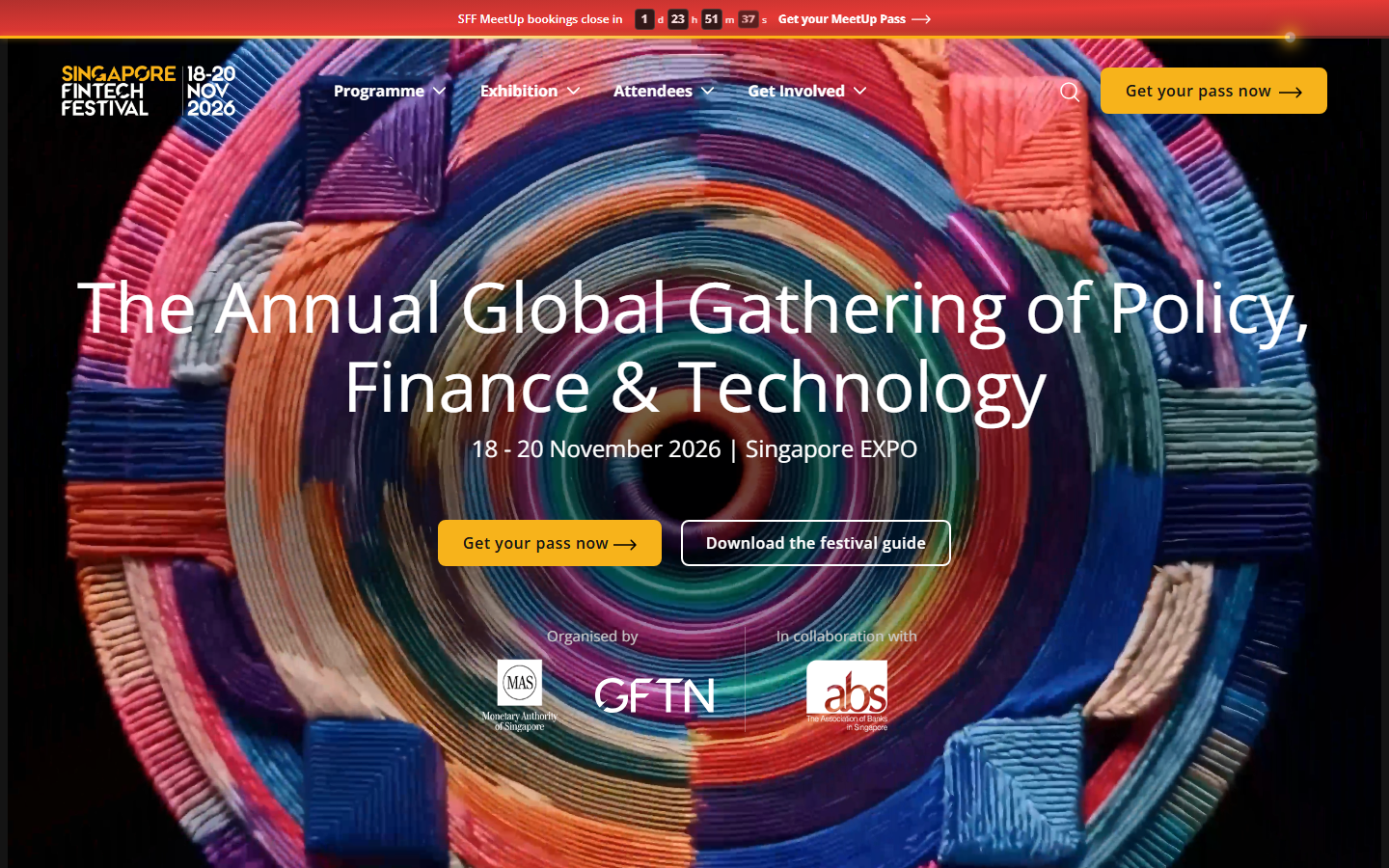
The Singapore FinTech Festival (SFF) runs November 18–20, 2026 at the Singapore EXPO. It is the largest fintech conference in Asia and one of the most closely watched by institutional crypto participants globally. MAS (Monetary Authority of Singapore) uses SFF as a primary venue for policy announcements — making it the equivalent of a regulatory Devcon for Southeast Asian financial markets.
This article covers the crypto and blockchain tracks confirmed for SFF 2026, what MAS signals are expected, and what the event means for crypto market development across Vietnam, Indonesia, Thailand, and the Philippines.
What Singapore FinTech Festival covers for crypto
SFF 2026 has confirmed blockchain and digital asset tracks covering three main areas:
Digital asset regulation and licensing. MAS has been one of the most systematically constructed regulators in the digital asset space. The annual SFF press conference from MAS leadership typically includes updates on the Major Payment Institution (MPI) license pipeline, new custody framework requirements, and forward guidance on institutional crypto product approvals.
In 2025, MAS announced the institutional DPT custody framework expansion at SFF. In 2026, the focus is expected to be on cross-border payment infrastructure using stablecoins and the MAS-supervised Singapore SGD stablecoin pilot results.
Project Guardian 2026 update. Project Guardian is MAS’s institutional DeFi initiative — a collaboration between MAS, DBS Bank, JPMorgan, Standard Chartered, and other financial institutions to test tokenized assets and institutional DeFi. Project Guardian has been running since 2022 and SFF 2026 is expected to announce the transition from pilot to production for at least two tokenization use cases.
Cross-border payment corridors. MAS’s cross-border payment work — connecting Singapore’s PayNow system with Thailand’s PromptPay, India’s UPI, and Malaysia’s DuitNow — is the most practically significant blockchain infrastructure project in Southeast Asia. SFF 2026 will include updates on extending these corridors and on the role of stablecoins in the system.
Expected MAS policy signals for Q4 2026
Based on prior SFF patterns and public consultation documents closed in Q3 2026:
Stablecoin issuer framework implementation. MAS finalized its Single Currency Stablecoin regulatory framework in 2023. Q4 2026 is when the first full operating cycle under the framework completes, and SFF is expected to include a regulatory review of how the framework has performed.
Digital asset custody rule update. The October 2026 MAS circular extending custody requirements to sub-custodians (the first extension since the framework launched) was explicitly flagged as the subject of further detail at SFF 2026.
Potential announcement on ETF approvals. Singapore has not approved a retail-accessible Bitcoin ETF. Multiple industry submissions have requested one. SFF 2026 is considered a plausible announcement venue if MAS decides to move in this direction — though the consensus expectation is that this announcement, if it comes, is more likely in 2027.
Impact on Vietnam, Indonesia, Thailand, and Philippines markets
SFF is not just a Singapore story. MAS’s regulatory frameworks are explicitly designed to be exportable — MAS has bilateral regulatory cooperation agreements with Vietnam’s State Bank, Bank Indonesia, Bangko Sentral ng Pilipinas, and the Bank of Thailand. Frameworks adopted by MAS typically influence regional regulators within 12–24 months.
Vietnam: The State Bank of Vietnam has been running a crypto regulatory pilot framework since 2023. MAS’s cross-border payment corridor framework is directly relevant — Vietnam-Singapore remittances are one of the largest bilateral flows in ASEAN. SFF 2026 developments in cross-border stablecoin payments have direct implications for Vietnamese migrant worker remittance infrastructure.
Indonesia: OJK (Indonesia’s financial services regulator) moved crypto oversight from the commodities regulator (BAPPEBTI) to OJK in 2024. OJK has been developing a crypto licensing framework that draws heavily on MAS’s MPI model. SFF 2026 MAS announcements on MPI framework adjustments will likely influence OJK’s next consultation paper.
Thailand: The SEC Thailand is deciding on its Bitcoin ETF framework in Q4 2026 (consultation closed Q3). A MAS announcement at SFF on Singapore’s own ETF approach — in either direction — will be watched closely by SEC Thailand as regional context for its own decision.
Philippines: BSP (Bangko Sentral ng Pilipinas) has the most developed Virtual Asset Service Provider (VASP) licensing framework in ASEAN. BSP’s approach has diverged from MAS in some respects but the two regulators maintain close dialogue through the ASEAN Financial Innovation Network (AFIN), which MAS co-chairs.
Who attends SFF from crypto
SFF 2026 attendance is expected to exceed 65,000 participants across 150+ countries based on 2025 figures. The crypto and digital asset attendee segment includes:
- MAS-licensed crypto exchanges (all 28+ active MPI license holders typically attend)
- Regional exchanges (Indodax, Bitkub, Coins.ph, VN exchanges via representatives)
- Global institutional players (Coinbase Institutional, OSL, HashKey)
- Tokenization infrastructure teams (Ondo Finance, Securitize, Backed Finance)
- Payment infrastructure providers (Circle, Paxos, Ripple for cross-border)
FAQ
What is the Singapore FinTech Festival?
The Singapore FinTech Festival is the world’s largest fintech conference by attendance, organized by MAS (Monetary Authority of Singapore) and Elevandi. It runs annually in November and serves as a primary venue for MAS policy announcements affecting digital assets and payment innovation.
Does MAS always make crypto announcements at SFF?
Yes, reliably. MAS leadership has made significant crypto regulatory announcements at every SFF edition since 2019. The announcements range from new framework consultations to license approvals to bilateral payment corridor expansions.
What is Project Guardian?
Project Guardian is MAS’s institutional DeFi initiative — a sandbox for testing tokenized bonds, digital currencies, and institutional DeFi protocols with major financial institutions. It has been running since 2022 and is transitioning from pilot to production for some use cases in 2026.
Is Singapore’s crypto regulation strict?
Selective is more accurate than strict. MAS approves fewer applicants than Hong Kong or Dubai but the approved licensees are regarded as among the most credibly regulated in Asia. The framework prioritizes institutional and sophisticated investor protection over retail accessibility.
Disclaimer: This article is for informational purposes only and does not constitute financial or investment advice. Cryptocurrency and digital asset markets carry significant risk. Always do your own research before making decisions.