



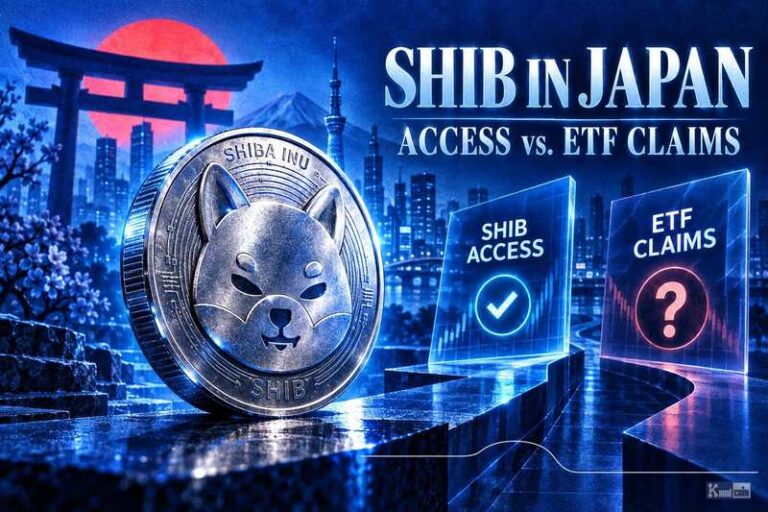
Shiba Inu has quietly widened its retail footprint in Japan, appearing on the country’s official self-regulatory Green List and inside the Mercari app, yet no Japanese SHIB ETF has been filed for or approved, a distinction that matters for Southeast Asian traders watching Tokyo for regulatory cues.
For exchanges in Jakarta, Manila and Bangkok, Japan often serves as a regional bellwether on how a mature Asian market treats memecoins. The current SHIB story is a case study in reading the fine print: broader exchange access is real, but it is not the same as a fund product, and the two are being conflated in community chatter. For related coverage, see WebX Conference Welcomes Distinguished Guests: Japan PM, Yuga Labs CEO, Kabosu (Doge), Desdemona (AI Robot).
- TLDR Keypoints
- ✅ Verified SHIB access: Japan’s Green List, dated September 1, 2026, includes SHIB with nine handling member firms, and Mercari-linked access began June 8, 2026 through Coincheck.
- ✅ Legal changes: Amendments to the Financial Instruments and Exchange Act and Payment Services Act passed in July 2026, but the record shows no ETF approval or effective date.
- ✅ Access is not an ETF: As of September 7, 2026, no Japanese SHIB ETF had been filed or approved, according to reporting reviewed for this story.
What Japan’s crypto law and exchange access mean for Shiba Inu
The two developments driving the SHIB headline are separate. One is a legislative package moving Japan’s crypto oversight closer to securities-style rules; the other is a widening of where retail users can actually buy the token. Neither one, on the evidence, creates a fund product. For related coverage, see B2BINPAY Releases Version 26.1 With Access Controls for Crypto Payment Operations.
What the reported crypto law changed
Japan’s Diet passed Cabinet Bill 57, amending the Financial Instruments and Exchange Act and the Payment Services Act, with House of Representatives passage on June 11, 2026 and House of Councillors passage on July 15, 2026, according to the official parliamentary record. The measure was promulgated on July 23, 2026 as Law No. 64. For related coverage, see What Crypto to Buy Now?: BlockDAG, Polygon, Shiba Inu, & Bonk Are Leading the Market.
Promulgation is not the same as an effective date, and the legislative record gives no ETF product approval or commencement date. For ASEAN regulators like Indonesia’s Bappebti or the Philippines’ SEC, that gap between a law’s promulgation and its operative rules is a familiar reminder that headline reform often precedes implementation by many months.
Where SHIB access has expanded
SHIB sits on the Green List published by the Japan Virtual and Crypto assets Exchange Association (JVCEA), dated September 1, 2026, which records nine member companies handling the token, per the association’s official list. Inclusion requires handling by at least three member firms, at least six months since one firm began handling the asset, no association-imposed special conditions, and no other grounds making listing unsuitable.
SHIB access in Japan
9JVCEA members handling SHIB
These are member counts, not investor counts. The same list records 29 handling members for BTC, 28 for ETH and 19 for XRP, so SHIB’s nine still trails the majors in exchange breadth. The recent access news helped SHIB break an 11-month downtrend after the Japan approval, though price direction is not evidence of fund eligibility.
On the consumer side, Mercoin added 12 assets, explicitly including Shiba Inu and Dogecoin, inside the Mercari app on June 8, 2026 through transactions with Coincheck. That brought the app’s listed total to 15 assets: the earlier Bitcoin, Ether and XRP plus the 12 Coincheck additions.
Access is tightly gated. Users need a Mercoin crypto account and an approved linked Coincheck account, and applicants under 18, aged 75 or older, or residing outside Japan are ineligible; existing independently opened Coincheck trading accounts cannot apply for the linked account. Coincheck is the trading counterparty, purchased crypto is segregated at Coincheck, and quoted prices include a spread despite no separate commission.
The scale numbers describe the platform, not SHIB buyers specifically. Mercoin reports more than four million cumulative account openings by March 31, 2026 and roughly 90% of surveyed users without prior crypto-trading experience. Four million historical openings do not translate into four million eligible SHIB purchasers, a caution worth keeping in mind given that retail investors still believe in investing in SHIB.
Why SHIB exchange access does not establish a SHIB ETF
The headline claim that “no SHIB ETF exists” needs scoping. As of September 7, 2026, no Japanese SHIB ETF had been filed for or approved in the materials reviewed by crypto.news, a dated and attributed finding rather than an exhaustive global registry check. Missing evidence of a filing does not prove worldwide nonexistence.
Trading SHIB versus buying ETF shares
Buying SHIB on Coincheck or via Mercari means owning the token directly, held in a segregated exchange account. An exchange-traded fund is a regulated investment vehicle whose shares trade on a stock exchange and track an asset; owning fund shares is a different form of exposure with a different legal wrapper. Green List handling conditions govern exchange listing, not fund creation.
What would confirm a SHIB ETF
A genuine SHIB ETF would require a named fund sponsor, a filing with the relevant regulator, approval, and then an actual launch with shares trading. None of the fetched primary documents, the JVCEA list, the Diet proceedings or the Mercoin announcement, identifies any such sponsor, filing or listing approval. Community claims that Green List status confers automatic ETF eligibility are, according to unconfirmed interpretation, not supported by the official records.
What to watch next for SHIB in Japan
The concrete items to monitor are the commencement orders and implementing rules that would give Law No. 64 operative effect, plus any future JVCEA or exchange notices affecting Japan-based users. These are separate from any fund development.
Any SHIB ETF filing, approval or launch should be treated as a distinct event requiring direct issuer and regulator records, not inferred from listing news. SHIB traded at $0.00000542 at the time of this research run, down about 0.75% over 24 hours, with broad market sentiment in Greed territory; wider access alone does not establish demand growth or a price increase.
For Southeast Asia, the read-through is procedural, not promotional. If regional venues like Tokocrypto, Indodax or Coins.ph eventually weigh similar memecoin listings, Japan’s model shows access can broaden under clear handling rules while fund products remain a separate, unproven step. Traders comparing tokens such as BlockDAG, Polygon, Shiba Inu and Bonk should keep exchange access and ETF status filed under different headings.
Disclaimer: This article is for informational purposes only and does not constitute financial or investment advice. Cryptocurrency and digital asset markets carry significant risk. Always do your own research before making decisions.