
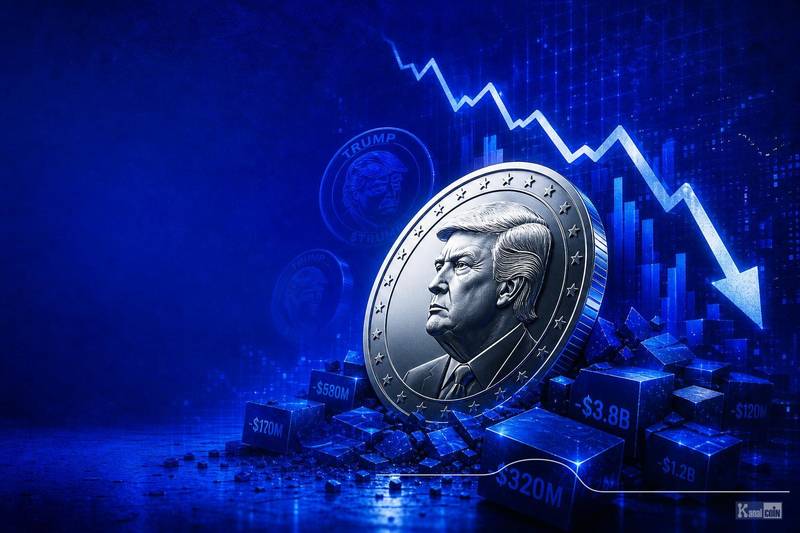
Buyers of the Official Trump memecoin are sitting on roughly $3.8 billion in collective losses, according to blockchain data analysis, underscoring the steep cost of speculative entry into politically branded crypto tokens.
What the $3.8 billion loss figure represents
TLDR KEYPOINTS
- Blockchain data indicates token buyers have accumulated approximately $3.8 billion in losses.
- The drawdown reflects the gap between aggregate purchase prices recorded on-chain and the token’s subsequent market value.
- Loss concentration appears heaviest among buyers who entered after major price spikes.
The $3.8 billion figure is derived from on-chain analysis comparing what buyers collectively paid for the token against its later trading value. Reporting from Crypto.news framed the loss as largely unrealized, meaning most affected wallets still hold the token rather than having sold at a loss. For related coverage, see $15 Billion Bitcoin Options Expire Friday as Trump Iran Deadline Looms.
This distinction matters. Unrealized losses reflect paper drawdowns based on current prices, not locked-in selling events. Still, the scale of the figure, roughly billions in everyday investor exposure according to MarketWatch, signals that the downside has been broad enough to affect a significant portion of the token’s buyer base. For related coverage, see Wallet Linked to Trump's World Liberty Sells 4,870 ETH.
Which buyers appear most exposed
On-chain wallet analysis typically reveals that loss concentration is heaviest among late entrants, those who bought during or immediately after sharp price spikes. The Trump token, which launched via its official site, attracted waves of speculative buyers drawn by political branding and social media attention.
Blockchain data can group wallets by entry timing and cost basis, showing clusters of buyers who purchased at elevated prices. While on-chain records reveal wallet behavior and transaction patterns, they cannot always identify the individuals behind those wallets, an important caveat in interpreting the scope of losses.
The pattern mirrors dynamics seen in other politically adjacent crypto projects. A wallet linked to Trump’s World Liberty project sold 4,870 ETH earlier this year, highlighting active treasury movements across Trump-branded crypto ventures. Separate concerns have also surfaced around WLFI token resale limits under Reg D/S, adding regulatory complexity to the ecosystem.
Why the drawdown matters beyond one token
A $3.8 billion aggregate loss carries weight beyond the Trump token itself. Drawdowns of this scale can suppress future buyer interest, reduce liquidity, and damage the credibility of similar celebrity or politically branded tokens.
Politically branded tokens tend to attract speculative capital driven by narrative momentum rather than fundamental utility. That dynamic amplifies both upside volatility on entry and downside exposure when momentum fades. The pattern has broader implications as crypto policy becomes a key factor in U.S. elections.
For traders and observers, the on-chain evidence serves as a concrete measure of hype-cycle risk in meme-driven crypto markets. The $3.8 billion figure anchors what might otherwise be abstract warnings about speculative tokens to verifiable blockchain records, the kind of transparency that crypto industry leaders at Davos 2026 have cited as essential for market maturation.
Disclaimer: This article is for informational purposes only and does not constitute financial or investment advice. Cryptocurrency and digital asset markets carry significant risk. Always do your own research before making decisions.