
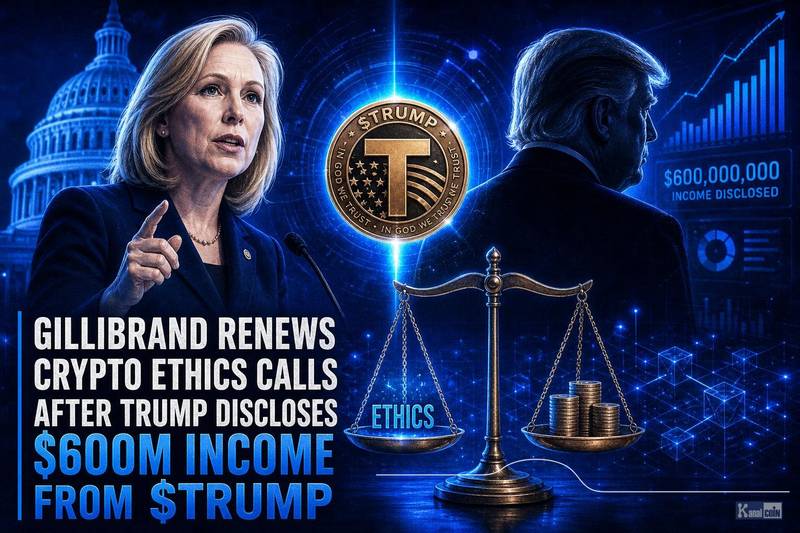
Sen. Kirsten Gillibrand renewed calls for crypto ethics rules after President Donald Trump’s 2026 financial disclosure revealed over $600 million in income linked to meme-coin licensing and digital asset ventures, intensifying a Capitol Hill debate over whether elected officials should profit from crypto while in office.
Key Takeaways
- Trump’s OGE filing shows $635 million in royalties from a Celebration Coins license agreement tied to meme-coin and NFT licensing.
- Gillibrand said no politician, including the president, should profit from public office, and called for bipartisan ethics reform targeting crypto income.
- The disclosure landed during Senate negotiations over the Clarity Act, where Democrats are pushing ethics language to restrict officials from profiting on digital assets.
Gillibrand revives the ethics case around crypto-linked political income
Gillibrand told The Block on July 1 that work is continuing on “rigorous, bipartisan ethics reform” that would ban presidents, vice presidents, and lawmakers from using crypto for personal profit. Her statement came hours after Trump’s annual Office of Government Ethics filing became public. For related coverage, see Senate Democrats Reaffirm Support for Crypto Legislation.
“No politician, including the president, should be profiting off of their public office.”
— Sen. Kirsten Gillibrand, via The Block
Gillibrand framed the issue as one of public accountability, not market regulation. Her argument centers on the conflict of interest created when a sitting president earns hundreds of millions from an asset class he also has the power to regulate through executive action and agency appointments. For related coverage, see Senate Democrats Introduce U.S. Crypto Regulation Framework.
The push fits within a broader legislative effort. Senate Democrats have reaffirmed support for crypto legislation that includes guardrails on official conduct, and Gillibrand has been among the most vocal advocates for tying ethics provisions to any market-structure bill. For related coverage, see U.S. Senate Moves Toward Crypto Market Structure Vote.
What Trump’s disclosure reveals about the $600 million figure
Trump’s 2026 OGE filing lists CIC Digital LLC as a business handling “License fees for NFT’s and meme coins.” Under that entity, a license agreement with Celebration Coins paid $635,068,835 in royalties. For related coverage, see Senator Cynthia Lummis to Retire, Impacts Crypto Legislation.
The filing does not explicitly name the $TRUMP ticker. Secondary reporting has connected the Celebration Coins royalty line to Trump’s memecoin business, but the OGE document itself identifies the counterparty by company name only.
Separate DeFi income adds to the total
Beyond the meme-coin royalties, the same disclosure shows DT Marks Defi LLC received $236,250,000 in net proceeds from token sales distributed by World Liberty Financial LLC. A separate equity sale in WLF Holdco LLC generated an additional $65,625,000.
Combined with the Celebration Coins royalties, the three crypto-related line items total more than $936 million. The “over $600 million” framing in public discussion refers primarily to the Celebration Coins figure, which is by far the largest single item.
The Official Trump token currently trades at roughly $1.80 with a market capitalization of approximately $426.3 million, a fraction of the royalty income the filing disclosed.
Why the disclosure could accelerate crypto ethics standards in Washington
Roll Call reported on July 2 that Trump’s disclosure intensified Senate negotiations over a crypto market-structure bill, with Democrats pushing ethics language to restrict how officials can profit from digital assets while serving.
The Senate Banking Committee advanced a substitute amendment on May 14 as part of the broader Clarity Act process. Democrats want that legislation to include provisions covering recusal requirements, disclosure timelines, and outright bans on certain token holdings by senior officials. The effort has echoes of the more than 130 crypto bill amendments senators have already proposed during this legislative session.
For crypto market participants, the stakes extend beyond Washington ethics. Political entanglement with specific tokens creates regulatory uncertainty. A president earning nine figures from meme-coin licensing while agencies draft token classification rules is precisely the scenario Gillibrand argues new legislation must prevent.
The Senate’s movement toward a crypto market-structure vote now carries an additional layer of complexity. Any bill that reaches the floor without ethics provisions will face Democratic opposition, while including them risks losing Republican support.
Gillibrand’s proposed guardrails would require elected officials to divest or place crypto holdings in blind trusts, disclose token-related income within 45 days, and recuse themselves from regulatory decisions affecting assets they hold. Whether those specifics survive negotiation remains an open question, but the disclosure has given reform advocates concrete numbers to build their case around.
Disclaimer: This article is for informational purposes only and does not constitute financial or investment advice. Cryptocurrency and digital asset markets carry significant risk. Always do your own research before making decisions.