


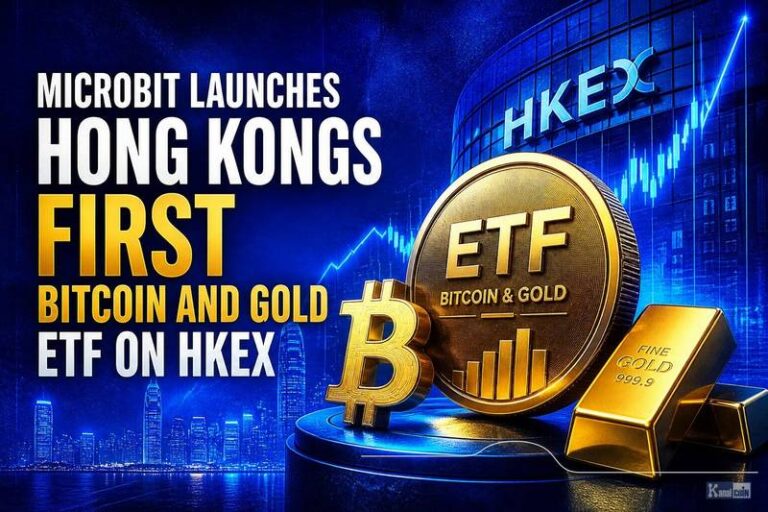
MicroBit has launched what it calls Hong Kong’s first combined Bitcoin and gold ETF on HKEX, bringing a single dual-asset product that pairs digital-asset exposure with a traditional safe-haven metal to one of Asia’s most closely watched exchanges.
What MicroBit launched on HKEX
The product is a combined Bitcoin and gold ETF issued by MicroBit and listed on the Hong Kong Stock Exchange, according to MicroBit’s launch announcement. The listing places the fund on HKEX, Hong Kong’s public equities venue. For related coverage, see Artificial Intelligence Summit –Philippines 2026.
MicroBit describes the fund on its own product page as pairing Bitcoin and gold in a single ETF structure, per the issuer’s product documentation. That framing, a dual-asset vehicle rather than a single-commodity or single-token fund, is what MicroBit is positioning as new for the market. For related coverage, see Artificial Intelligence Summit –Malaysia 2026.
Why the Hong Kong-first claim matters
MicroBit is marketing the fund as Hong Kong’s first combined Bitcoin and gold ETF, a claim central to the news value of the launch, as reported in coverage of the listing. The novelty rests on the pairing itself: most listed crypto and commodity ETFs track a single asset.
Combining Bitcoin with gold in one wrapper is unusual because the two assets are often held for different reasons, one as a high-volatility digital asset and the other as a long-standing store of value. Packaging both into a single HKEX-listed instrument gives investors one line item for exposure that would otherwise require two separate products.
What this launch could signal for ETF demand in Hong Kong
For regional investors, the appeal of a blended vehicle is straightforward: access to Bitcoin’s upside alongside gold’s defensive profile without managing two positions. How much demand that draws will depend on the market response once trading settles.
The listing also fits a broader push to build regulated digital-asset infrastructure in Hong Kong, a hub that Southeast Asian investors increasingly watch alongside Singapore. The city has recently expanded its regulated crypto footprint, including moves such as Standard Chartered becoming the first bank distributor of an HKD stablecoin.
Elsewhere in ASEAN, regulators are advancing their own frameworks, with Thailand progressing draft rules for spot Bitcoin and Ether ETFs and setting out SEC draft conditions for those products. A dual-asset structure listing in Hong Kong gives regional market watchers a live example of how exchanges are experimenting with product design.
What to watch next is adoption: trading volumes, inflows, and whether other issuers in Hong Kong or across Southeast Asian venues follow with similar blended products.
Disclaimer: This article is for informational purposes only and does not constitute financial or investment advice. Cryptocurrency and digital asset markets carry significant risk. Always do your own research before making decisions.