


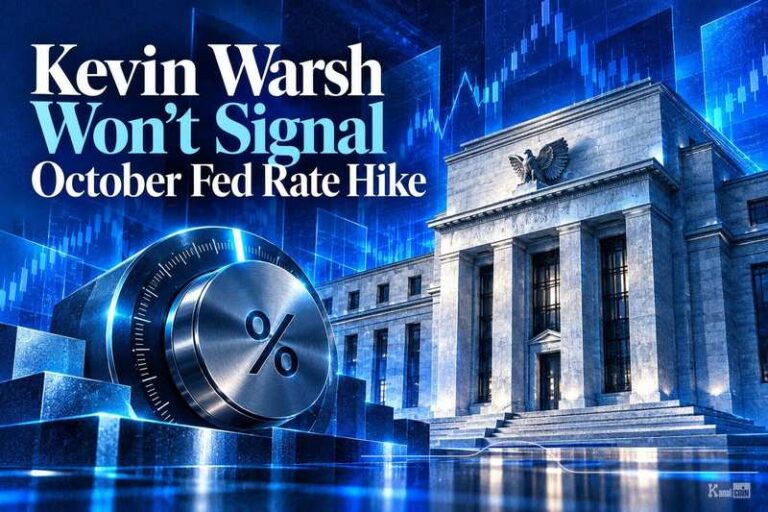
Federal Reserve Chair Kevin Warsh declined to signal whether the Federal Open Market Committee will raise interest rates again at its October meeting, leaving traders and market participants without a clear directional cue heading into one of the most closely watched policy decisions of the year.
The lack of forward guidance from Warsh stops well short of ruling out another hike. Declining to signal is distinct from ruling one in or out; the October decision remains openly conditional on incoming economic data and the Fed’s internal assessment of inflation progress. Official communications from the Federal Reserve’s news and events page have not confirmed a specific path for the October meeting. For related coverage, see Polymarket Odds of Oct. 28 Fed Rate Hike Fall to 35%.
KEY POINTS
- Warsh declined to pre-commit the FOMC to another rate increase in October.
- The October decision remains conditional; no official guidance has been published.
- Traders should monitor upcoming Fed communications and macro data releases for signals.
What Warsh Said, and What Remains Undecided
Warsh’s remarks, delivered at an IMF fireside chat, produced no commitment on the October rate path. The Fed Chair’s deliberate ambiguity signals that the committee intends to preserve optionality rather than telegraph its next move in advance. For related coverage, see Bitcoin Back Above $77,500 as XRP Leads Majors on Lower Fed Hike Odds.
The key takeaway from Warsh’s remarks
By refusing to signal, Warsh keeps both a hike and a pause on the table. Markets cannot price in a definitive outcome until further data arrives or the Fed publishes updated communications ahead of the October meeting. For related coverage, see AINext Awards & Conference Singapore 2026: Where AI Leaders, Innovators and Decision-Makers Shape the Future of Artificial Intelligence.
What the Fed has not decided publicly
No vote count, preferred rate level, or policy timeline for October has been disclosed. The FOMC’s next formal decision point is the October meeting itself. Until then, traders are operating without authoritative forward guidance from the Fed chair.
Why Unresolved Rate Guidance Matters for Crypto Markets
Interest-rate expectations shape risk appetite globally. When the Fed’s path is uncertain, assets perceived as risk-on, including Bitcoin, Ethereum, and XRP, can see elevated volatility as institutional positioning shifts. Previous episodes where Bitcoin and Ether swung after a Fed rate hike illustrate how sensitive crypto prices can be to policy surprises.
Rate expectations and risk assets
An unresolved October hike scenario keeps the US dollar and Treasury yields in flux. A surprise hike could strengthen the dollar and compress demand for dollar-denominated risk assets; a pause could have the opposite effect. Neither outcome is currently confirmed. Prediction market odds for an October 28 rate hike have recently sat at 35%, reflecting the same uncertainty Warsh’s remarks reinforced.
Why crypto traders watch Fed communication
In Southeast Asia, where retail participation in crypto is high across markets such as Indonesia, the Philippines, and Thailand, US monetary policy transmits quickly through dollar liquidity conditions. Regional exchanges including Indodax and Coins.ph operate in currencies sensitive to dollar strength; a surprise Fed hike tends to tighten local liquidity faster than headline rates suggest. When Warsh avoids signaling, regional traders lose a key anchor for near-term positioning. Earlier this cycle, Bitcoin fell to $78.4K after Warsh downplayed soft inflation data, showing how the chair’s tone alone can move markets even without a formal policy change.
What to Watch Before the October FOMC Meeting
Fed communication to monitor
Any scheduled Fed speeches, board member interviews, or minutes releases before the October meeting could revise the market’s probability estimate for a hike. The official calendar of upcoming Fed events is published on the Federal Reserve’s newsevents page. A FOMC member breaking the silence with a clearer signal would be the most direct catalyst for repricing.
Data that can reshape rate expectations
Inflation readings (CPI, PCE), labor market reports (non-farm payrolls, unemployment), and consumer sentiment data are the standard inputs the FOMC weighs before each decision. A materially hotter-than-expected inflation print would strengthen the case for another hike; softening labor data would do the opposite. For crypto markets in the region, prior episodes have shown that sliding Fed hike odds can lift Bitcoin and altcoins quickly, making macro data releases an event risk for regional traders to track closely.
Disclaimer: This article is for informational purposes only and does not constitute financial or investment advice. Cryptocurrency and digital asset markets carry significant risk. Always do your own research before making decisions.