Orbs has launched Orbs Agentic, an execution layer designed to sit between AI agents and DeFi protocols, marking the project's push into autonomous on-chain automation across eight EVM-compatible networks.
The product, introduced as a dedicated infrastructure layer for DeFi agents, is positioned to handle routing, verification, and on-chain execution for automated strategies. Phase 1 is live now as a proof-of-concept, supporting swaps and conditional orders through Orbs' existing execution model.
Under the system's design, agents sign EIP-712 order intents while the Orbs network manages the downstream execution pipeline. The approach is described as gasless and oracle-verified, removing the need for agents to interact directly with on-chain gas mechanics.
What Orbs Agentic does and how it fits DeFi automation
Orbs Agentic is not a wallet or an agent framework. It is an execution and verification layer, a middleware that translates agent-generated intents into verified on-chain actions. The distinction matters because most DeFi automation tools bundle agent logic with execution, while Orbs is isolating the execution step as standalone infrastructure.
The system is available across Ethereum, BNB Chain, Polygon, Arbitrum, Base, Avalanche, Sonic, and Linea, covering eight EVM ecosystems at launch. That breadth positions it as a multi-chain execution backend rather than a single-network tool.
Ran Hammer, associated with the Orbs project, framed the problem the product is solving in direct terms.
"The missing piece in DeFi is less about reasoning and more about execution."
— Ran Hammer, via Orbs launch announcement
The practical use cases for an agentic execution layer include automated portfolio rebalancing, rule-based order execution, and conditional swaps triggered by price thresholds or on-chain events. These are workflows that DeFi users currently handle manually or through fragmented tooling, and the types of operations that large position managers and whale traders increasingly rely on.
A key caveat: the current release is explicitly a proof-of-concept. Orbs has not yet demonstrated broad third-party adoption, and the scope of Phase 1 is limited to swaps and conditional orders rather than complex multi-step strategies.
Network track record and market position
The Orbs Agentic product page states that the network's execution infrastructure has handled $2.2 billion in executed volume since 2022, with over 1 billion ORBS staked on the network. These figures provide some baseline for the infrastructure's operational history, though they reflect Orbs' broader execution products rather than Agentic specifically.
The project's launch blog separately cites over $14 billion in cumulative on-chain volume. That figure could not be independently verified and conflicts with the $2.2 billion executed-volume number on the live product page. No public dashboard was found to reconcile the difference.
ORBS traded at roughly $0.00805 on April 1, with a market cap near $39.74 million and approximately $2.26 million in 24-hour trading volume. The token was down about 3.7% over the prior 24 hours.
Why execution infrastructure matters for DeFi's next phase
The broader DeFi market that Orbs Agentic targets remains substantial. Ethereum alone held roughly $111.02 billion in total value locked as of April 1, 2026, according to DeFiLlama data.
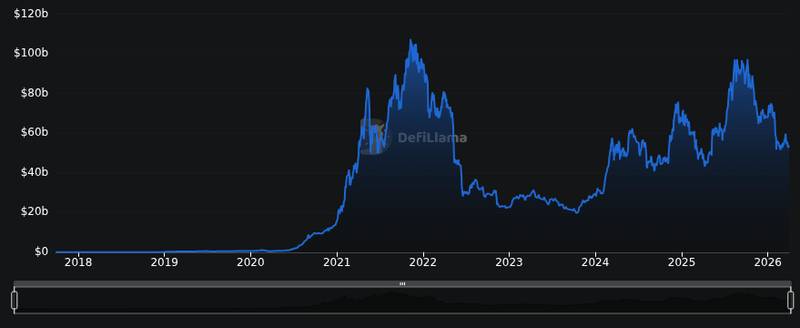
As DeFi protocols grow more complex and capital flows increase, the demand for automated execution grows with it. Manual trading and strategy management become bottlenecks at scale, particularly across multiple chains. This is the gap that infrastructure projects like Orbs Agentic are designed to fill, similar to how institutional market-making infrastructure has evolved to support professional trading operations.
The agentic execution model also raises questions about security and trust. Automated systems that can execute swaps and orders on behalf of users require robust verification layers, particularly in an environment where sophisticated attack vectors continue to target crypto infrastructure. Orbs' use of oracle-verified execution and EIP-712 signed intents addresses part of that concern, though the proof-of-concept stage means the system has not yet been stress-tested at scale.
Third-party reaction to the launch has been limited so far. A TradingView listing treated the announcement as a proof-of-concept whose market significance depends on actual integrations and developer adoption rather than the announcement itself. Whether Orbs Agentic moves beyond its beta phase will depend on whether DeFi protocols and agent developers choose to route execution through its infrastructure.
Disclaimer: This article is for informational purposes only and does not constitute financial or investment advice. Cryptocurrency and digital asset markets carry significant risk. Always do your own research before making decisions.